Marking a Rabbit's Anniversary Without Scaring Them
Published
This article is based on literature research by our editorial team and has not been individually reviewed by a veterinarian. References are listed at the end of the article.
Please note: This article is not veterinary treatment. It summarises publicly available information from welfare organisations and specialist sites. What a rabbit can eat, and how much, varies between individuals — ask your vet if your rabbit has a health condition or is unwell.

What anniversaries do rabbit owners mark?
The day they came home, and their birthday. Beyond that, you decide.
Rescue and pet-shop rabbits often arrive without a known birth date. Most owners in that position simply use the adoption day, or pick a date from the estimated age and leave it at that.
There is a global date too. The US rabbit care site rabbit.org writes that International Rabbit Day falls on the last Saturday in September and was initiated by The Rabbit Charity in the UK in 1998. The same page suggests marking it with educational events or adoption drives.
The rabbit, of course, has no idea. What the date is actually good for is making you look at your rabbit more carefully than usual.
How do you photograph a rabbit without frightening them?
Get down to the floor. That one change does more than any camera setting.
The RSPCA puts it plainly: "Interact with your rabbit at ground level. This is less likely to scare them." A person standing over a rabbit and reaching down has the same shape as a predator arriving from above.
RWAF describes how to close the distance: start by letting them come to you, use hand feeding as a reward, and go at the rabbit's pace. So the order is not catch-then-photograph. It is wait at their level, and photograph what comes to you.
Boxing a rabbit up so they stay still for the shot is worth avoiding too. A rabbit holding still is not necessarily a rabbit at ease.
Can I pick my rabbit up for the photo?
Better not to. Being lifted is, for a rabbit, what being caught feels like.
RWAF is direct about why. Rabbits are a prey species that lives on and under the ground; in the wild the only time they would be picked up is just before becoming a predator's dinner, and fear of being lifted is hardwired into their genes.
When lifting really is necessary, RWAF describes the hold: one hand under the chest with a couple of fingers between the front legs, the others around the outside of one leg and the thumb around the other, the second hand scooping up the bottom, then bring them close to your body as quickly as you can so they feel secure. The RSPCA adds that one hand should support the back and bottom at all times, holding all four feet against your body.
Two things are simply off the table. Never lift by the ears — RWAF writes that there is "no need for it, and no excuse". And never hold a rabbit on their back: the stillness people call trancing is, in RWAF's words, extremely cruel, because the rabbit is in fact terrified.
No photograph is worth either of those.
Are treats alright on a special day?
With the right kind and amount. What to avoid is most of the "rabbit treat" aisle.
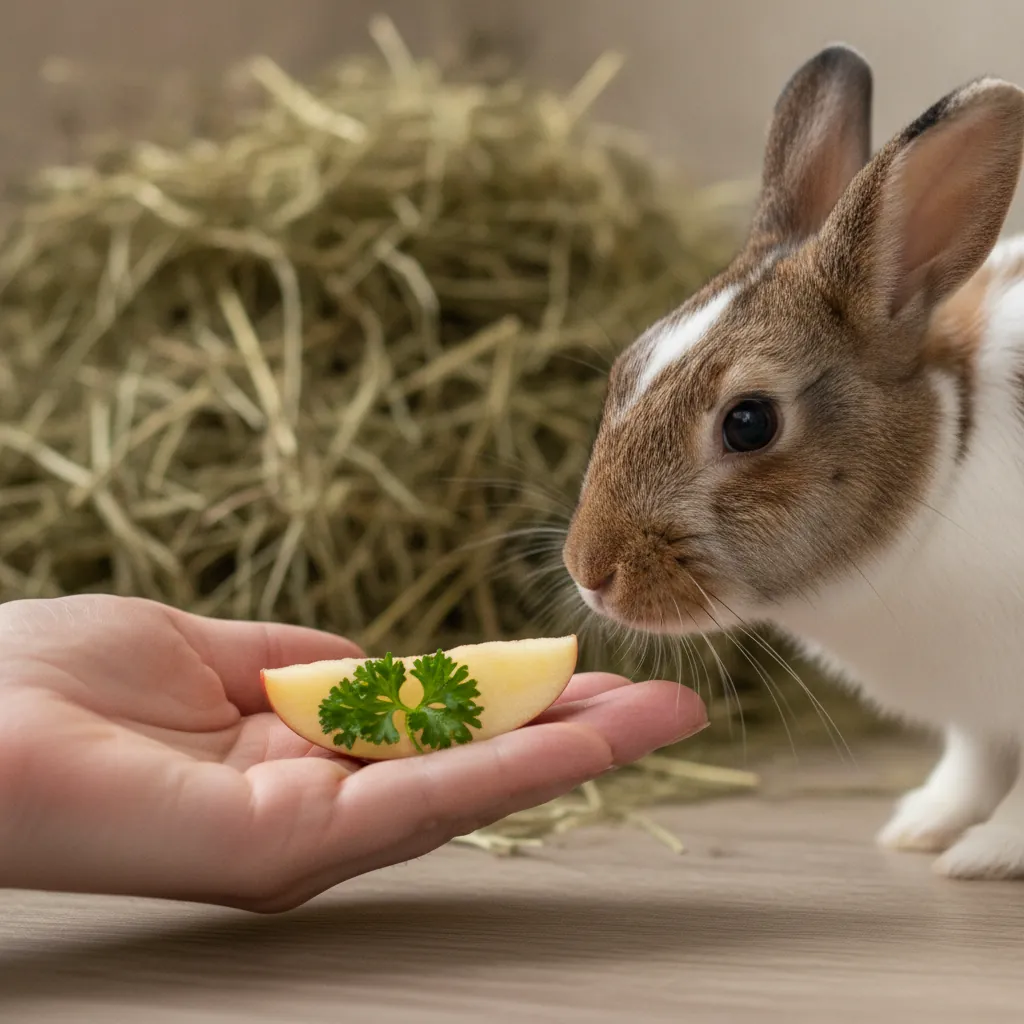
The UK's PDSA says shop-bought rabbit treats "are often high in sugar — which is bad for their teeth, guts and waistline". If you want to give something special, it recommends fresh veg, plants, herbs, or a very small amount of fruit.
The quantity is specific: about 1/8th of an apple or pear. Apple pips are poisonous and should be removed. Banana, melon, kiwi, plum and strawberry appear on the safe-in-small-amounts list.
All of that sits on top of the main rule: PDSA puts around 85% of the diet as hay and/or grass. A celebration treat is whatever fits without disturbing that 85%. Banana quantities are covered in "Can Rabbits Eat Bananas? Safe Amount and Frequency", and choosing hay in "Choosing Hay for Rabbits: Cuttings, Grass Types and Alfalfa".
What does the rabbit actually enjoy most?
More room to move. It changes the other 364 days, which a treat does not.
Germany's TVT asks that rabbits always have somewhere to dig a hollow, a hideaway for each animal, and a raised resting place. For an outdoor run it sets at least 6 m² for two rabbits, at a height where a rabbit sitting up does not touch the roof with its ears.
So if the anniversary comes with a purchase, a tunnel, a digging box or one more panel on the pen will do more than anything edible.
Cardboard is the easy version. RWAF describes cardboard boxes as enrichment to be filled with hay and as bolt holes where a rabbit can feel safe. There are conditions, though. Tape and string can block the gut if swallowed and should not be anywhere a rabbit can reach. Staples and other metal fixings, especially sharp ones, should never be used because of the risk of perforation. Glue should be non-toxic, water soluble and used in the smallest amounts possible; resin-based glues not at all. RWAF adds that if a rabbit is eating a lot of cardboard rather than just enjoying destroying it, the cardboard should be removed and a vet consulted.
If you are reusing a delivery box, strip out every bit of tape and every staple first. Where that is too much trouble, a box designed to slot together without fixings removes the question. What to have in place is listed in "Before You Bring a Rabbit Home: Checklist and Space".
What actually shows a year of change?
Weight, and a photo from the same angle. Those two are the honest records.
Weighed once a week at the same time of day, the numbers become a line where seasonal and age-related changes are visible. An anniversary is a good day to look back along it — how to weigh is in "Rabbit Weight: Weekly Weighing and Reading the Change".
For photographs, one shot a year from the same spot at the same angle carries far more information than a hundred random ones. Coat colour, the set of the ears, body shape: those only show up side by side.
How do you keep the memory in a form you'll see?
Files you never open are not really kept. Something physical survives better.
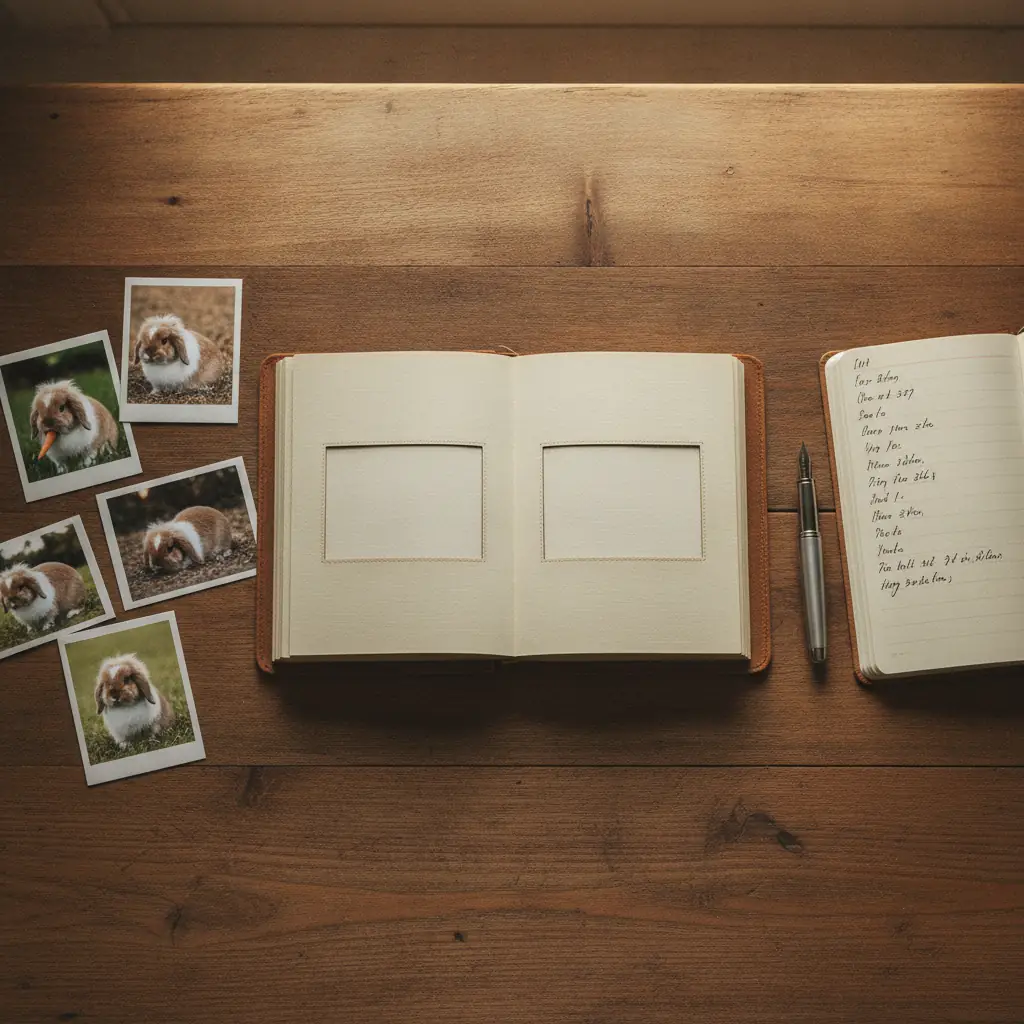
Print a few photographs, make a photo book at the end of the year, copy the records into a notebook. None of it needs special equipment. There are also services that draw a portrait from a photo, some of which cover pets.
The one thing worth checking is whether the method asks anything of the rabbit. Anything that involves holding them for a long session, or taking them somewhere unfamiliar, misses the point of the day. Anything made from photographs you already have does not.
The more you record, the more anniversaries you have
What were you doing this day last year? Once you can answer that, one date turns into several.
The first day they ate hay unprompted. The first time they stretched out flat to sleep. The day the weight came back up. With a record, you can find the turning points afterwards.
The usagi Diary app logs food, droppings and weight in about thirty seconds. The daily entries are there for health, but after a year they double as an index to the memories.
What a rabbit can eat, and how much, varies between individuals. Ask your vet if your rabbit has a health condition or is unwell.
Keep the record in the usagi Diary app
The log you keep is what you show the vet when something changes. Available on iPhone and Android.
Frequently asked questions
What anniversaries do rabbit owners mark?
The day the rabbit came home, and their birthday. For a rescue rabbit with no known birthday, many owners use the adoption day instead. rabbit.org gives International Rabbit Day as the last Saturday in September.
How do you photograph a rabbit without frightening them?
Get down to floor level. The RSPCA says interacting at ground level is less likely to scare them, and RWAF advises starting by letting the rabbit come to you rather than reaching for them.
Can I pick my rabbit up for the photo?
Better not to. RWAF says fear of being lifted is hardwired into their genes. If lifting is necessary, support the chest and bottom and hold them close to your body. Never lift by the ears.
Are treats alright on a special day?
With the right kind and amount. PDSA says pet-shop rabbit treats are often high in sugar, which is bad for teeth, guts and waistline, and recommends fresh veg, herbs or a very small amount of fruit — about 1/8th of an apple.
What does the rabbit actually enjoy most?
More space. The TVT asks for somewhere to dig, a hideaway per rabbit and a raised resting place. Room to move changes daily life more than any treat does.
Related articles
References
- How to Handle Pet Rabbits Safely and Calmly / Rabbit Welfare Association & Fund (RWAF, UK) (accessed 2026-09-30) Link
- Handling Rabbits - How To Pick Up a Rabbit / RSPCA (UK) (accessed 2026-09-30) Link
- Feeding your rabbits / PDSA (People's Dispensary for Sick Animals, UK) (accessed 2026-09-30) Link
- Celebrating International Rabbit Day: Advocating for Our Furry Friends / rabbit.org (rabbit care information site, US) (accessed 2026-09-30) Link
- Merkblatt Nr. 157: Kaninchen (Heimtierhaltung) [Information sheet no. 157: Rabbits (keeping as pets)] / Tierärztliche Vereinigung für Tierschutz e.V. (TVT, German veterinary animal welfare association), September 2019 (accessed 2026-09-30) Link
- Cardboard Safety for Rabbits: Expert Vet Advice / Rabbit Welfare Association & Fund (RWAF, UK) (accessed 2026-10-02) Link