
What Does Rabbit Vet Care Cost? Data and How to Prepare
Published
This article is based on literature research by our editorial team and has not been individually reviewed by a veterinarian. References are listed at the end of the article.
Note: This article is not veterinary advice. It summarises publicly available statistics on treatment costs. The figures come from Japanese insurance data and are intended as an order of magnitude — actual costs vary widely by condition, region and practice. If you notice anything concerning, please contact a rabbit-savvy exotic veterinarian promptly.

How often do rabbits actually need a vet?
Japanese insurance data shows that one rabbit in three is treated for illness or injury within a single year. That is more frequent than most owners expect.
Rabbits have a reputation for being low-maintenance. On health costs, that reputation does not hold. They hide discomfort, so by the time symptoms are visible, treatment is often already needed.
Unlike human healthcare, there is no public insurance scheme — the bill generally falls entirely on the owner.
How much do costs rise with age?
Annual treatment costs roughly double between the first and fourth year. Budgeting from the figures for a young rabbit will understate what comes later.
| Age | Average annual treatment cost |
|---|---|
| 0 years | approx. 26,500 yen |
| 4 years | approx. 56,500 yen |
Rabbits commonly live seven to eight years, so four is not even halfway. Expect costs to keep climbing into the senior years.
For what to watch day to day, see 5 Things to Observe When Your Rabbit Isn't Eating.
Which conditions come up most often?
Digestive disorders. One rabbit in five is treated for them, with average annual costs running from about 16,400 yen at age zero to 31,000 yen at three to four years.
The spread is what stands out. The same dataset includes a single case exceeding 540,000 yen in a year. An average alone does not describe the risk.
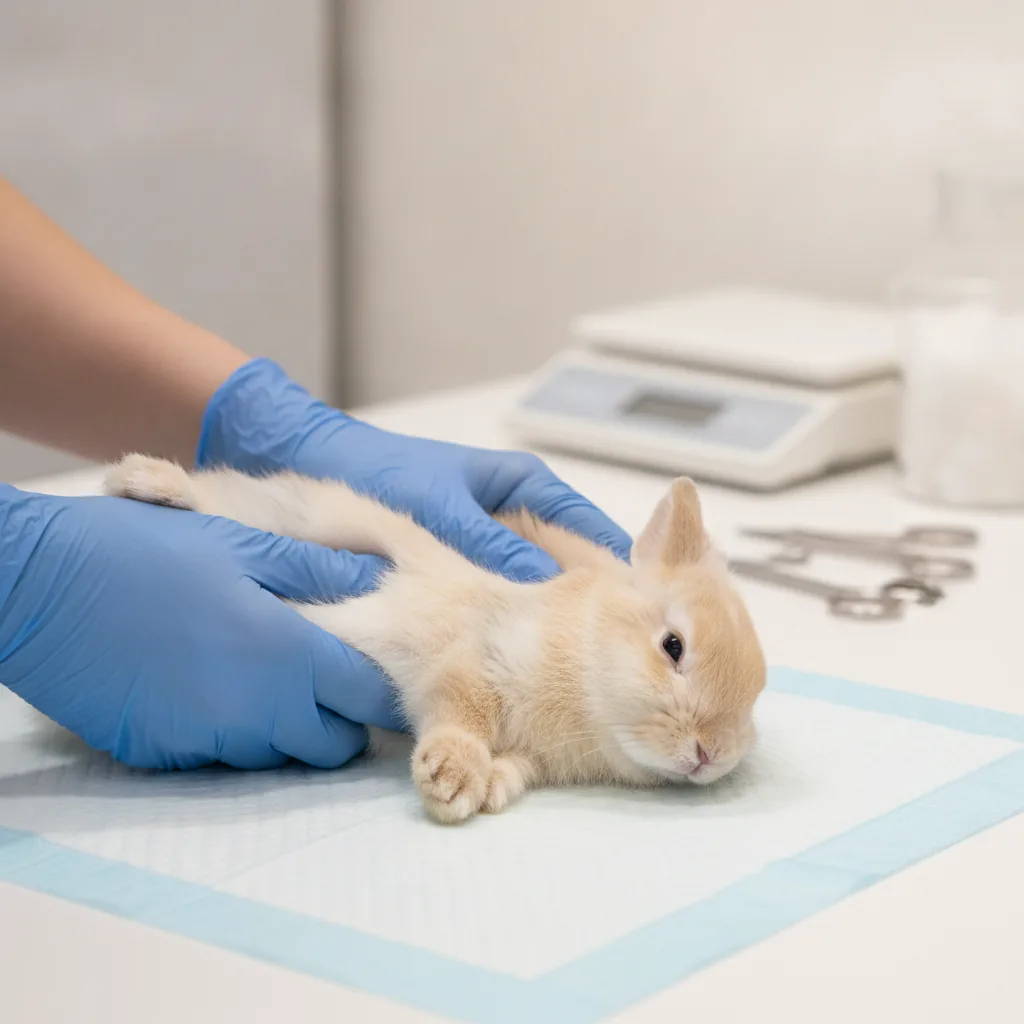
The House Rabbit Society notes that gut problems in rabbits progress quickly and early action matters. RWAF lists urgent signs as: eating nothing at all, no droppings, lethargy, and laboured breathing.
The biggest cost driver is how long it takes to notice. The later treatment starts, the longer and more expensive it becomes.
How often is surgery needed?
One rabbit in fifty has surgery, at an average cost of about 99,000 yen. Uncommon — but in a different league when it happens.
If you have budgeted around 50,000 yen a year, a surgical month lands close to double that in one go. Preparation should be sized to the individual event, not the average.
Is insurance worth it, and what are the alternatives?
That depends heavily on your market. Rabbits are covered far less often than dogs and cats, and many policies exclude them entirely.
Where no suitable policy exists, a dedicated savings buffer is the workable answer: a set monthly amount reserved only for veterinary costs. Given roughly 50,000 yen in annual costs plus the possibility of surgery, a buffer around 100,000 yen is a reasonable starting point.
If you do evaluate a policy, check: are rabbits actually included? What is the reimbursement rate and annual cap? Does it cover consultations or only surgery? Is there an age limit for joining?
Why does the age you join matter?
Because policies often set an age limit. In Japan, one major insurer stops accepting new rabbit policies at four years old, while existing policies continue for life.
That cut-off sits exactly where costs start climbing. By the time expenses feel high enough to justify insurance, the door may have closed. The principle holds even where the specific terms differ.
What does keeping a rabbit cost overall?
A 2024 Japanese survey puts total annual spending at about 168,300 yen per rabbit, with lifetime costs often described as around one million yen. What such a figure does and does not include, and how UK and German estimates compare, is covered in "What Rabbits Cost: Why the Figures Disagree So Much".
The components given include food and consumables at 3,000–5,000 yen a month, and additional heating and cooling costs of 36,127 yen a year — roughly 3,000 yen monthly.

Beyond the numbers, a few habits help:
- Choose a rabbit-experienced practice in advance. In an emergency there is no time to search
- Note down out-of-hours and weekend options
- Keep temperature and humidity stable — see Rabbit Winter Care
Why record-keeping saves money
Costs hinge on how quickly something is noticed. Knowing the normal baseline is what makes changes visible.
usagi Diary records meals, droppings and weight in about 30 seconds. Weight trends and appetite shifts show up in the numbers even when a rabbit is hiding discomfort. For reading body language, see Is My Rabbit Cold?.
If something seems off, do not wait it out — early assessment is gentler on the rabbit and on the bill.
Keep the record in the usagi Diary app
The log you keep is what you show the vet when something changes. Available on iPhone and Android.
Frequently asked questions
How often do rabbits need a vet?
Japanese insurance data shows one rabbit in three is treated for illness or injury within a single year. Vet visits are not an unusual event for rabbit owners.
Do costs rise as a rabbit ages?
Sharply. In the same dataset, average annual treatment costs run about 26,500 yen at age zero and about 56,500 yen at age four — roughly double.
What conditions are most common?
Digestive disorders. One rabbit in five is treated for them. The range is wide: from tens of thousands of yen to one documented case above 540,000 yen in a year.
How often is surgery needed?
One rabbit in fifty undergoes surgery, at an average cost of about 99,000 yen. Uncommon, but a large sum when it happens.
Is pet insurance worth it for a rabbit?
It depends on what is available where you live — rabbits are covered far less often than dogs and cats. Where no suitable policy exists, a dedicated savings buffer is the practical alternative.
Related articles
References
- うさぎにペット保険は必要?知っておきたいうさぎのペット保険のこと [Does a rabbit need pet insurance? What owners should know] / anicom Encyclopedia of Living with Rabbits (Anicom Insurance, Japan) (accessed 2026-09-13) Link
- うさぎの飼育費用はいくらかかる?年間支出調査大発表! [What does it cost to keep a rabbit? Annual spending survey] / anicom Encyclopedia of Living with Rabbits (Anicom Insurance, Japan) (accessed 2026-09-13) Link
- Recognising emergencies / Rabbit Welfare Association & Fund (RWAF, UK) (accessed 2026-09-13) Link
- Common Medical Problems / House Rabbit Society (accessed 2026-09-13) Link