
Before You Bring a Rabbit Home: Checklist and Space
Published
This article is based on literature research by our editorial team and has not been individually reviewed by a veterinarian. References are listed at the end of the article.
Please note: This article is not veterinary treatment. It is a summary of publicly available information from welfare organisations and companies. If your rabbit's appetite drops or droppings stop after coming home, please contact a rabbit-savvy vet promptly.
What do I need to have ready before bringing a rabbit home?
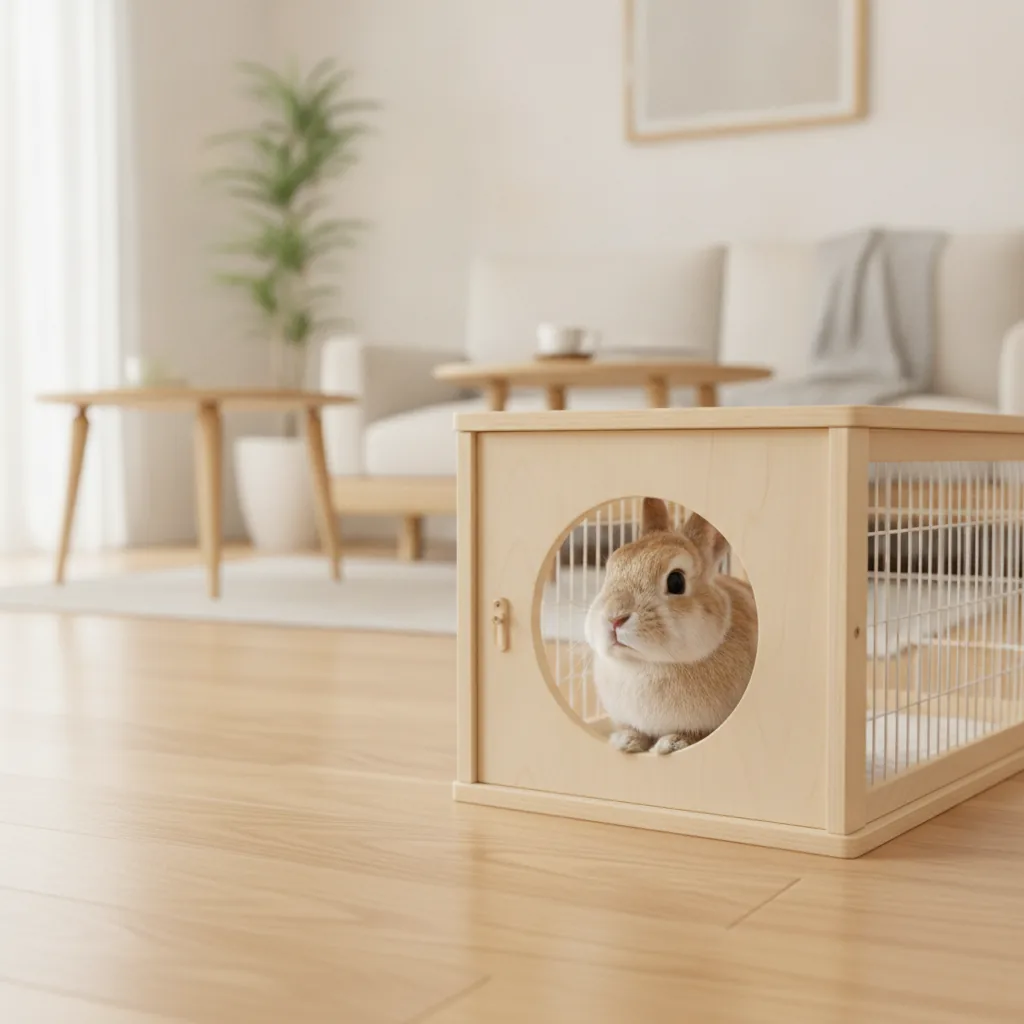
An enclosure, water bottle, hay rack, food bowl, litter tray, plus hay and pellets. That is enough to start.
The anicom guide lists a water bottle, a hay rack, a litter tray and a food bowl as things that must be inside the enclosure — on the condition that with all of them in place there is still room for the rabbit to stretch out and relax.
On hay it is unambiguous: hay is the staple and must be available to eat at all times, topped up whenever it runs low rather than at set meal times. Which hay to buy is covered in "Choosing Hay for Rabbits: Cuttings, Grass Types and Alfalfa".
Treats and supplements can wait. What the first few days call for is food, a place to hide and quiet.
How big should the enclosure be?
Cages sold for rabbits in Japan are mostly 50-80cm wide. Buy for the adult size, not the baby in front of you.
According to anicom, rabbit cages on the Japanese market are commonly 50-80cm wide, 40-60cm deep and 50-60cm high. The guide warns that because adult size varies by breed, you should not choose based on how big the rabbit is as a baby.
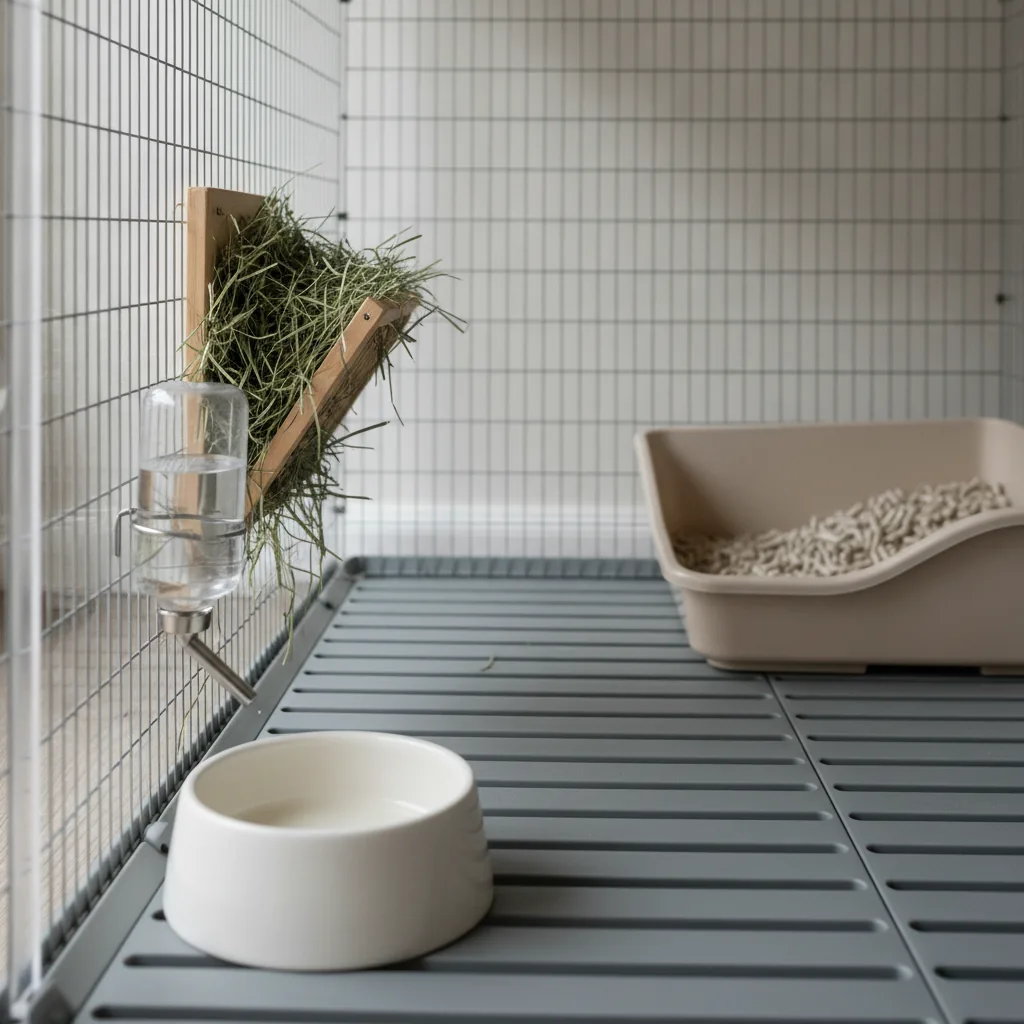
Flooring gets the same treatment. Coarse wire mesh floors are described as hard on the feet and a possible cause of sore hocks and other skin problems, with fine mesh, plastic or wooden floors recommended instead.
Then there is height. The same guide notes that rabbits have light, fragile bones and can fracture one simply by jumping down from somewhere high, so a step or ramp at the doorway is worth having. It also keeps an older rabbit able to come and go on its own.
How much space do welfare organisations actually ask for?
The UK's RWAF and RSPCA ask for 3m x 2m by 1m high for two rabbits at all times; Germany's TVT sets a floor of 6m² for two.
RWAF recommends, for two average-sized rabbits (and on the premise that they should be kept at least in pairs), "a single enclosed area of at least 3m x 2m by 1m high". Sleeping quarters may count, but the upper floor of a two-storey hutch, platforms and tunnels do not count towards the footprint. The 3m length exists so rabbits can "run rather than just hop", which is why a squarer layout of the same area can fail the guideline. And the space must be available at all times, not for limited periods.
The sleeping quarters themselves should be at least 1.8m x 0.6m x 0.6m high. On top of that RWAF states plainly: "A hutch should never be the sole or main accommodation for rabbits."
The RSPCA likewise puts two medium rabbits at no less than 3m x 2m and 1m high, and adds a test anyone can apply: they must be able to stand fully on their back legs without their ears touching the roof.
The TVT works in floor area. Permanent housing for two rabbits needs at least 6m², plus at least 20% more for each additional animal. If a cage is used at all it must be at least 150 x 60 x 50cm and serve only as a retreat, with the door removed so it always stands open. Keeping rabbits in a cage alone, the guidance says, is not compatible with animal welfare given current scientific knowledge.
Few homes meet those numbers exactly. What all three share, though, is the idea that the cage is the bed, not the home. Time out of it and a straight line to run along get you closer to the standard than a bigger cage does.
Where in the room should the enclosure go?
Indoors, away from windows, air conditioning airflow and doorways. Leave a clear run in front of it.
anicom is specific: the enclosure belongs indoors, and the places to avoid are windows with large temperature swings, anywhere the air conditioning blows directly, and noisy doorways. The guide also asks for enough space in front of the enclosure for the rabbit to have a light run during daily free-roam time. Deciding where the enclosure goes is really deciding where the rabbit runs.
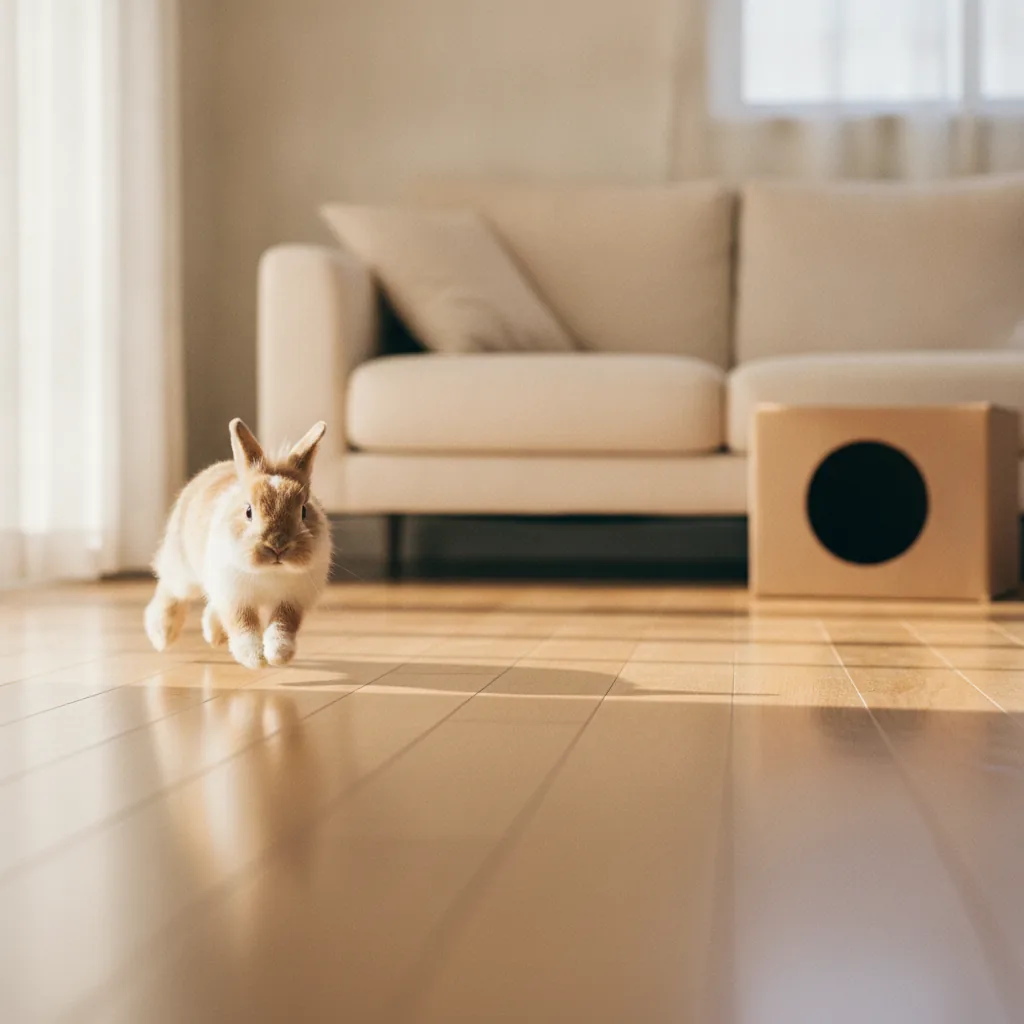
There is a rule of thumb for hiding places too. The RSPCA says there should be as many hiding places as there are rabbits, plus one if possible, in varying sizes so they can hide together or separately.
Keep the toilet area separate from the sleeping area. The RSPCA suggests cleaning the toilet daily and the whole enclosure about weekly, putting a little used bedding back so a familiar smell remains.
One rabbit or two?
This is where the sources part company. Either way, space and time with you are non-negotiable.
TVT (Germany) states that rabbits are social animals and that keeping one alone should in principle be rejected, recommending at least two and preferably a pair. RWAF writes that "rabbits suffer if kept alone", and closes the usual escape route: the argument "I don't have room for two, so I'll just have one" does not hold water, because a single rabbit needs the same minimum space as two. The RSPCA likewise asks for at least one compatible companion, while noting they need room to be together and room to be alone.
The Japanese picture is different. anicom's article on multi-rabbit households stresses the risks: it is "no exaggeration to say that rabbits meeting for the first time will fight", and if the reason for a second rabbit is loneliness, it "cannot really be recommended". It adds that a rabbit whose owner spends time with it will not be lonely without another rabbit.
This is not a question with one correct answer. If you do go for two, introductions should happen on neutral ground rather than the resident rabbit's territory, and settling in can take months. TVT recommends neutering males; whether surgery is right depends on age and condition, so discuss it with your vet.
What should the first day look like?
Let them rest without handling. Put out hay and water, and watch only how much goes in and what comes out.
The RSPCA advises starting "by getting your rabbits used to your presence and your voice without any physical contact", then sitting on the floor and offering food or a toy and letting the rabbits come to you — never forcing interaction.
The TVT is blunter: rabbits are not cuddly pets, and should be stroked only when they want it. When lifting one, avoid leaning over the animal (an overhead shadow reads like a bird of prey), and the guidance rejects lifting by the scruff or by the ears.
Two things are enough to watch on day one: is hay being eaten, and are droppings appearing. How to read them is in "Rabbit Poop Guide: Size, Count and Caecotrophs", and if eating stops, see "5 Things to Observe When Your Rabbit Isn't Eating".
What should I decide before the rabbit arrives?
Find a vet who treats rabbits. That matters more than anything you buy on the day.
Unlike cats and dogs, practices that see rabbits are limited. Starting the search once something is wrong is too late. Opening hours, closing days, out-of-hours cover and how long the drive takes are all worth knowing in advance — as is the likely cost, which is covered in "What Does Rabbit Vet Care Cost? Data and How to Prepare".
Temperature and humidity are the other thing to plan for; see "Rabbit Winter Care: Temperature and Where to Put a Heat Mat".
Start recording on day one and it pays off later
"Not like usual" only means something once you know what usual is. That baseline starts the day they arrive.
The first week is exactly when appetite and droppings swing, because everything around the rabbit has changed. That first week of notes is what becomes the baseline.
The usagi Diary app lets you log food, droppings and weight in about thirty seconds. If a vet visit comes, being able to show when things changed is information only you can bring.
Rabbits differ. When in doubt, a vet's advice comes before anything you try at home.
Keep the record in the usagi Diary app
The log you keep is what you show the vet when something changes. Available on iPhone and Android.
Frequently asked questions
What do I actually need before bringing a rabbit home?
An enclosure, a water bottle, a hay rack, a food bowl, a litter tray, plus hay and pellets. The anicom guide treats those four fittings as essentials inside the enclosure. Treats and supplements can wait.
How big should a rabbit's enclosure be?
Cages sold for rabbits in Japan are typically 50-80cm wide. RWAF and the RSPCA, however, ask for 3m x 2m by 1m high for two rabbits, available at all times — a cage alone is not treated as the home.
Where in the room should the enclosure go?
Indoors, away from windows with big temperature swings, direct airflow from air conditioning, and noisy doorways. Leaving a clear run in front of the enclosure makes daily free-roam time much easier.
Is a single rabbit lonely?
Sources disagree. Germany's TVT and the UK's RSPCA advise against keeping a rabbit alone, while a Japanese anicom article warns that two rabbits meeting for the first time will almost certainly fight.
What should the first day look like?
Let them rest without handling. The RSPCA suggests getting them used to your presence and voice first and letting the rabbit come to you. Put out hay and water, and watch only intake and droppings.
Related articles
References
- Minimum Space Requirements for Pet Rabbits / Rabbit Welfare Association & Fund (RWAF, UK) (accessed 2026-09-17) Link
- Rabbit environment / RSPCA (UK) (accessed 2026-09-17) Link
- Merkblatt Nr. 157: Kaninchen (Heimtierhaltung) [Information sheet no. 157: rabbits kept as pets] / Tierärztliche Vereinigung für Tierschutz e.V. (TVT, German veterinary animal welfare association), Stand September 2019 (accessed 2026-09-17) Link
- うさぎを飼う前の準備|ケージはどんなものを用意したらいい?噛んでしまうときはどうする? [Preparing before you get a rabbit: which cage, and what if they chew it?] / anicom Encyclopedia of Living with Rabbits (Anicom Insurance, Japan) (accessed 2026-09-17) Link
- うさぎは多頭飼いしない方がいいって本当?リスクを避けて多頭飼いをするには [Is it true rabbits shouldn't be kept in groups? How to avoid the risks] / anicom Encyclopedia of Living with Rabbits (Anicom Insurance, Japan) (accessed 2026-09-17) Link