Rabbit Weight: Weekly Weighing and Reading the Change
Published
This article is based on literature research by our editorial team and has not been individually reviewed by a veterinarian. References are listed at the end of the article.
Please note: This article is not veterinary treatment. It is a summary of publicly available information from welfare organisations and veterinary practices. If you notice a sudden drop in weight, a fall in appetite, or anything else that worries you, please contact a rabbit-savvy vet promptly.
What should I compare my rabbit's weight against?
Their own usual weight and shape. Breed averages will not tell you whether your rabbit is overweight.
In its shape guide, the UK's PDSA writes that "a rabbit's shape is a better way to tell if they're carrying extra weight rather than relying on the scales alone. That's because the ideal weight is different for every type and breed — but a healthy shape is the same for all rabbits."
A Japanese guide from anicom lands in the same place: among rabbits of the same breed there are individuals around 1kg and others near 2kg, so breed and weight alone cannot decide whether a rabbit is fat. What matters is a weight that suits that individual's frame.
The scales, then, are not a verdict. They are the tool that tells you this rabbit's normal, so you notice when it moves. PDSA makes the same point: once you know their ideal weight and shape, judging whether they are gaining or losing becomes easy.
How should I weigh a rabbit?
Once a week, under the same conditions. If they hate being held, weigh yourself with and without them.
Aloha Ohana Animal Hospital, a Japanese practice with an exotics department, puts it simply in its health-check guide: weigh once a week, and treat a sudden drop as a warning sign.
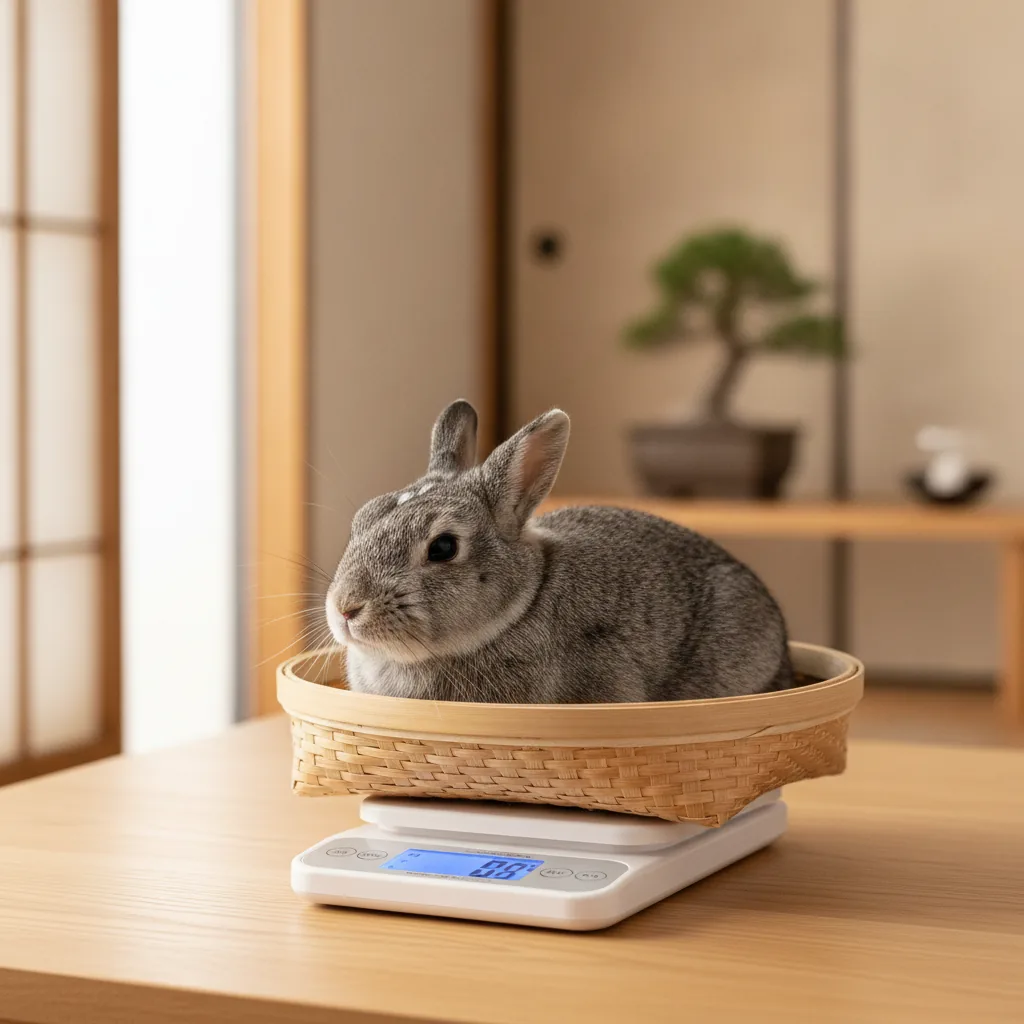
For rabbits that dislike handling, PDSA gives a method: weigh yourself, then pick the rabbit up and weigh yourself again. The difference is the rabbit's weight. If the rabbit is too small for an accurate reading that way, a vet can weigh them on special scales.
Putting them in a basket or carrier on a kitchen scale and subtracting the container works too. What matters is keeping it identical each time — same time of day, same container. Before and after a meal can differ by tens of grams.
Where do I feel to check body condition?
Four places: the ribs, the spine, the base of the tail and the belly. Easy to feel, not sticking out.
The PDSA shape guide needs nothing but looking and feeling.
- Sides: run your hands over them; the skin should move freely over ribs that are easy to feel
- Back: the spine and hipbones should be felt quite easily under the skin, but not stick out
- Tail base: squeeze gently where it joins the spine; there should be no build-up of fat
- Under the tummy: it should go in, not bulge out
- From the side and above: there should be a waist; if not, the rabbit may be a bit overweight
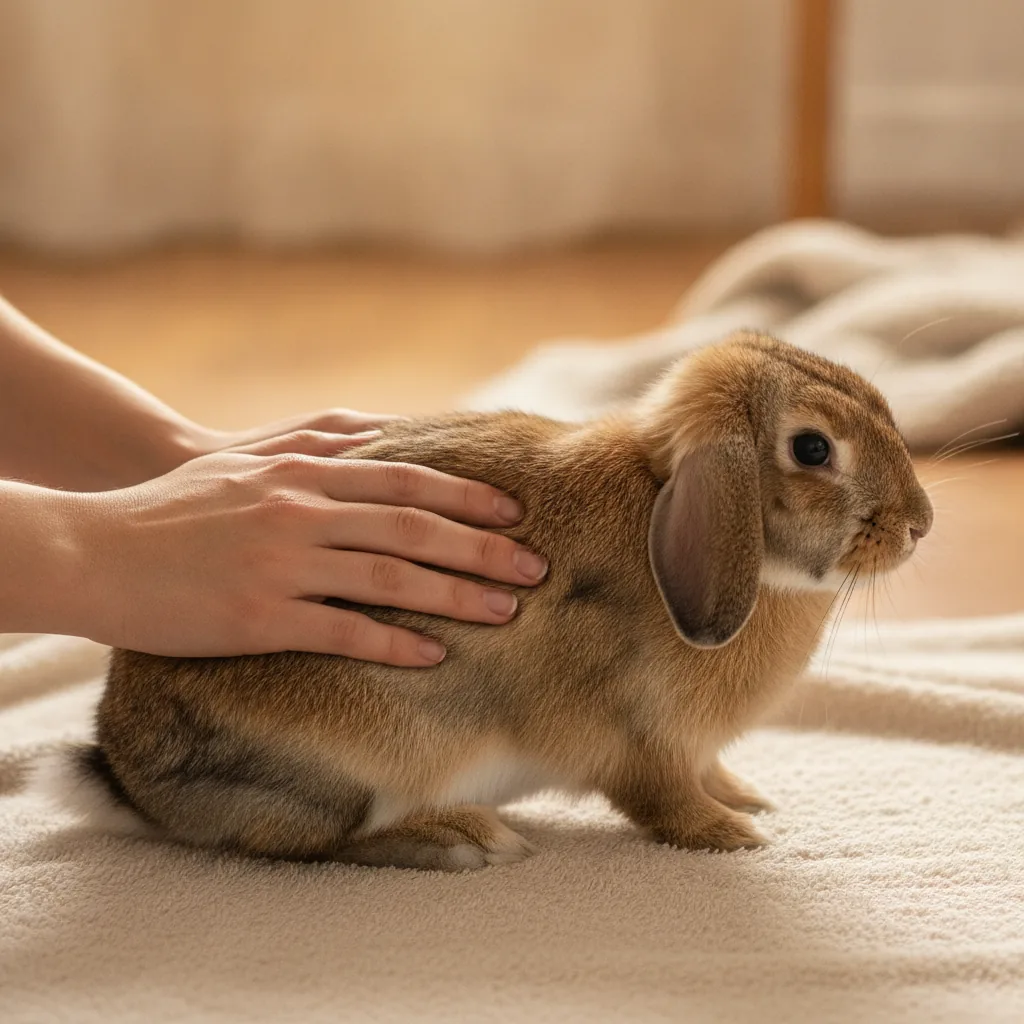
The same guide sets out a three-point body condition score. 1 very thin: muscle loss, the rump curving in, ribs and other bones sharp to the touch. 2 ideal: no abdominal bulge, a flat rump, bones felt but not seen. 3 obese: pronounced fat layers, a bulging rump, ribs and bones no longer felt. It suggests getting into the habit of checking every few weeks, starting when the rabbit is young.
Can I tell by looking?
Fur makes it hard. There are, however, a few signs that are easier to catch.
anicom lists what a possibly overweight rabbit looks like: a rounded belly with less clearance from the floor, a body that looks large for the head, uneaten caecotrophs on the floor, and grooming that is no longer being done.
The last two follow from a body that can no longer bend. RWAF explains that fat rabbits cannot reach their bottom to eat their caecotrophs, which raises the risk of skin infections and flystrike. How to read the droppings is covered in "Rabbit Poop Guide: Size, Count and Caecotrophs".
The risks go further. PDSA lists heart disease, arthritis, liver disease, flystrike and skin problems such as urine scald. anicom adds arthritis and sore hocks, fatty liver and gut stasis, and notes that surgery under anaesthetic becomes harder on a heavier rabbit.
What should I suspect when the weight falls?
That they are not eating properly. Dental problems in particular show up on the scales before anywhere else.
anicom's article on ageing gives two ordinary reasons for weight loss — lower calorie needs and muscle loss — then adds that teeth may have become painful enough to stop the rabbit eating, and that a rapid drop can hide an illness, so an early appointment matters.
RWAF makes the same connection from the other side: you cannot check the back teeth at home, but dental trouble shows itself when a rabbit dribbles, loses weight, changes its favourite foods, or stops eating altogether. The scales are one of the few windows into a mouth you cannot see.
The sources checked here give no gram figure for when to go. It is the speed of the change, not the number, that they point to. For what to watch when appetite falls, see "5 Things to Observe When Your Rabbit Isn't Eating".
What should I review when the weight rises?
Diet and exercise, in most cases. Start with the pellets — and leave the hay alone.
PDSA writes that weight gain in rabbits "is nearly always because of too much food and too little exercise, and very rarely due to a medical problem". It still advises a check-up if the gain has no obvious cause or will not shift, partly to rule out pregnancy in an unneutered female.
The quantities are expressed differently by different sources. anicom puts pellets at 3-5% of body weight while growing (up to seven months) and 1.5-2% for adults; RWAF limits them to 15g per kg of body weight. Both land near or below 2% of body weight for an adult. anicom adds that rabbits tend to gain more easily after neutering.

What gets reduced is pellets and treats; hay stays unlimited, as anicom also states. Choosing it is covered in "Choosing Hay for Rabbits: Cuttings, Grass Types and Alfalfa".
Can I start a diet on my own?
See a vet before you do. What looks like fat is sometimes disease.
anicom advises not to start a diet on your own judgement, but to have a vet confirm first whether the rabbit is overweight enough to need it and whether illness is behind it — in females, a swollen abdomen can be uterine disease.
PDSA also starts weight loss at the vet, and gives the reason: losing weight too quickly can cause liver problems. It suggests keeping a food diary for a week and taking it to the appointment, which makes it easier to see where the extra calories come from.
On how often to have a health check, the sources differ. The vet-reviewed anicom article calls once every one to two months ideal; Aloha Ohana Animal Hospital says at least once a year, twice a year from five years old; PDSA says at least annually. Less important than which is right is picking a rhythm you can actually keep.
A weekly note becomes next year's evidence
One reading means nothing on its own. Only as a line does it show whether a rabbit is gaining or losing.
According to the PDSA PAW Report 2023, only 37% of rabbit owners know their pet's current weight (dogs 68%, cats 47%). 19% know their rabbit's body condition score, and 70% had weighed their rabbit within the last 12 months, against 91% of dog owners.
The usagi Diary app turns those weights into a graph. Through a moult, when appetite swings anyway, a line is what separates a temporary dip from a downward trend — see also "Autumn Moulting in Rabbits: Diet, Weight and Warning Signs".
Rabbits differ. When in doubt, a vet's advice comes before your own judgement at home.
Keep the record in the usagi Diary app
The log you keep is what you show the vet when something changes. Available on iPhone and Android.
Frequently asked questions
How often should I weigh my rabbit?
A Japanese exotics clinic suggests once a week, treating a sudden drop as a warning sign. Weighing at the same time of day, in the same container, makes the numbers comparable.
How do I weigh a rabbit that hates being picked up?
PDSA suggests weighing yourself, then weighing yourself again holding the rabbit; the difference is their weight. If they are too small for an accurate reading, your vet can weigh them on proper scales.
How many grams of loss means a vet visit?
The sources checked here give no gram threshold. What they point to is the speed: a sudden drop is described as a warning sign, and an early appointment is advised rather than watching and waiting.
How can I tell whether my rabbit is overweight?
PDSA treats shape as more reliable than the scales. Check that ribs and spine can be felt easily without sticking out, that the tummy goes in rather than bulging, and that there is a waist from above.
Can I put my rabbit on a diet myself?
Both anicom and PDSA say to see a vet first. A swollen belly can be uterine disease rather than fat, and PDSA warns that losing weight too quickly can cause liver problems.
Related articles
Spotting Dental Trouble in Rabbits: Eating, Drooling, Face
Rabbit Poop Guide: Size, Count and Caecotrophs
Autumn Moulting in Rabbits: Diet, Weight and Warning Signs
Rabbit Heatstroke: Signs, Prevention, and Safe Summer Setup
Rabbit Shedding Care: Brushing and the Real GI Stasis Risk
5 Things to Observe When Your Rabbit Isn't Eating
References
- Obesity in rabbits / PDSA (People's Dispensary for Sick Animals, UK) (accessed 2026-09-18) Link
- Getting your rabbits into shape / PDSA (People's Dispensary for Sick Animals, UK) (accessed 2026-09-18) Link
- PAW Report 2023: Rabbits / PDSA (People's Dispensary for Sick Animals, UK) (accessed 2026-09-18) Link
- Obesity, Commercial Food and Treats / Rabbit Welfare Association & Fund (RWAF, UK) (accessed 2026-09-18) Link
- Bunny MOT / Rabbit Welfare Association & Fund (RWAF, UK) (accessed 2026-09-18) Link
- 太ってるかも?うさぎの肥満はどう見極める?肥満の原因とリスク、対策も [Maybe overweight? How to spot obesity in rabbits, its causes, risks and what to do] / anicom Encyclopedia of Living with Rabbits (Anicom Insurance, Japan) (accessed 2026-09-18) Link
- 高齢になるとどうなる?うさぎの老化のサインと対処法 [What changes with age: signs of ageing in rabbits and what to do] / anicom Encyclopedia of Living with Rabbits (Anicom Insurance, Japan) (accessed 2026-09-18) Link
- 獣医師に聞いてみた!うさぎの健康診断はすべき?頻度は? [We asked a vet: do rabbits need health checks, and how often?] / anicom Encyclopedia of Living with Rabbits (Anicom Insurance, Japan; reviewed by the veterinarian Tetsuya Nagaoka / 長岡哲矢) (accessed 2026-09-18) Link
- ウサギの健康チェック|食欲・うんち・尿・体重から体調不良のサインを早期発見 [Rabbit health checks: spotting illness early through appetite, droppings, urine and weight] / Aloha Ohana Animal Hospital, Kamogawa Park Small Animal Clinic (Japan) (accessed 2026-09-18) Link