Autumn Moulting in Rabbits: Diet, Weight and Warning Signs
Published
This article is based on literature research by our editorial team and has not been individually reviewed by a veterinarian. References are listed at the end of the article.
Please note: This article is not veterinary advice. What is appropriate varies with the individual rabbit, existing conditions and age. If you notice worrying changes, please see a vet experienced with rabbits promptly.
What matters most in a rabbit's diet during an autumn moult?
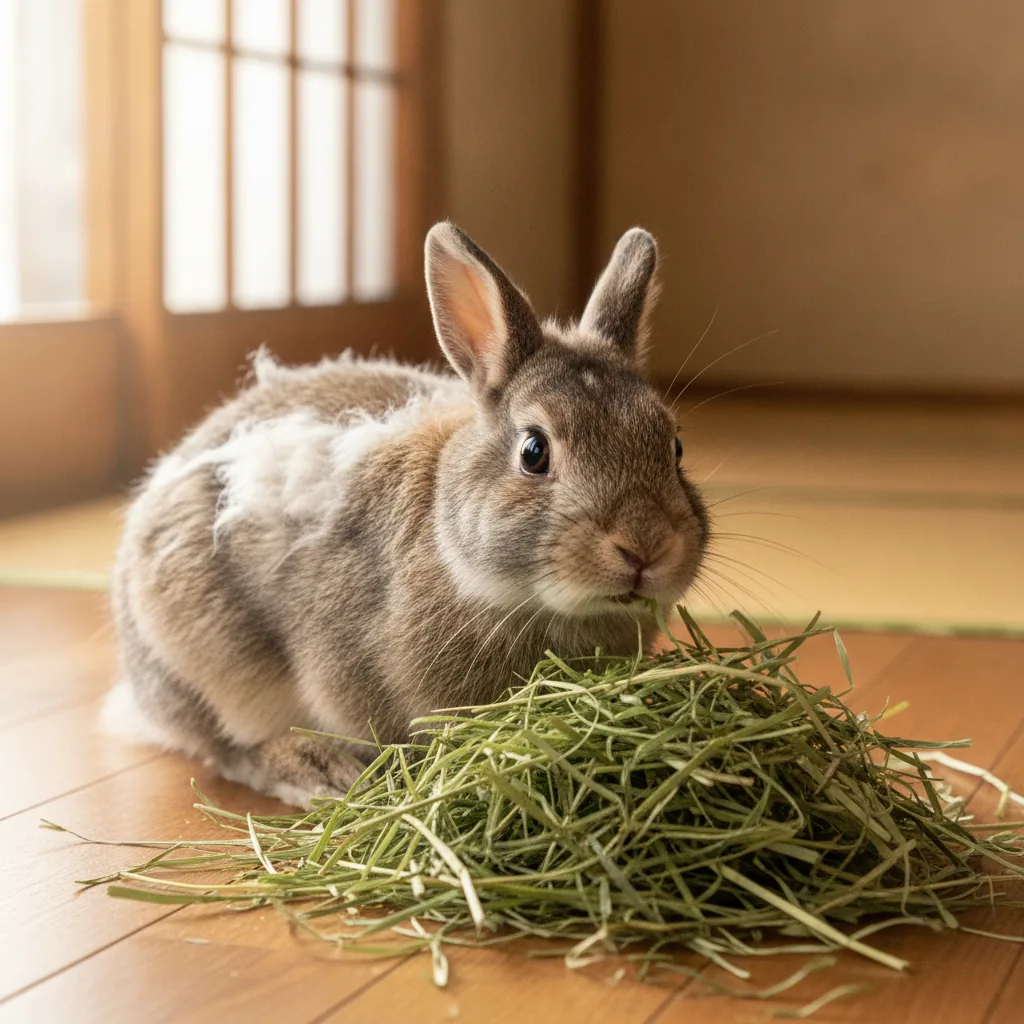
Never letting fibre run out. If appetite or weight drops while a winter coat is being grown, do not put it down to the moult.
When shed fur starts appearing everywhere, attention naturally goes to removing it. From the rabbit's side, though, a moult is the middle of building new fur, and keeping the gut moving is the foundation.
This article draws on published guidance from the Rabbit Welfare Association & Fund (RWAF) in the UK, the German veterinary animal welfare association (TVT) and the House Rabbit Society in the US, and focuses on three things: food, weight and water. For brushing and hairballs, see rabbit moulting season care.
When and why does the autumn moult happen?
The autumn moult is one of two a year, and it exists to replace the coat with a warmer one for winter.
RWAF states that rabbits generally moult twice a year, in spring and autumn. It adds that house rabbits live in conditions different from wild rabbits, so their patterns vary more, and some appear to moult almost constantly.
The German rabbit-keeping site Kaninchenwiese likewise describes the autumn moult as growing a warming winter coat, and suggests indoor temperature changes help trigger it. Setting up the environment for that swing between day and night is covered in autumn temperature swings and rabbits.
There is an order to it. RWAF describes the moult starting at the head, spreading down the neck and back and along the sides, finishing at the rump, sometimes with a visible line where the new coat meets the old.
Is a smaller appetite during a moult something to watch and wait on?
No. The German veterinary association TVT states plainly that a rabbit refusing food is always an emergency.
TVT guidance note 157 contains the sentence "Futterverweigerung stellt immer einen Notfall dar!" — refusal of food always constitutes an emergency.
The House Rabbit Society says the most common reason for weight loss is decreased appetite and the reduced calorie intake that follows. It adds that rabbits cannot fast, not even when ill or injured, and that they do not have much of an energy reserve. Going without food for around twenty-four hours is described as cause for concern.
In the sources reviewed here, nothing supported treating a reduced appetite as an acceptable part of moulting. For how to observe a rabbit that has gone off its food, see five things to check when a rabbit stops eating.
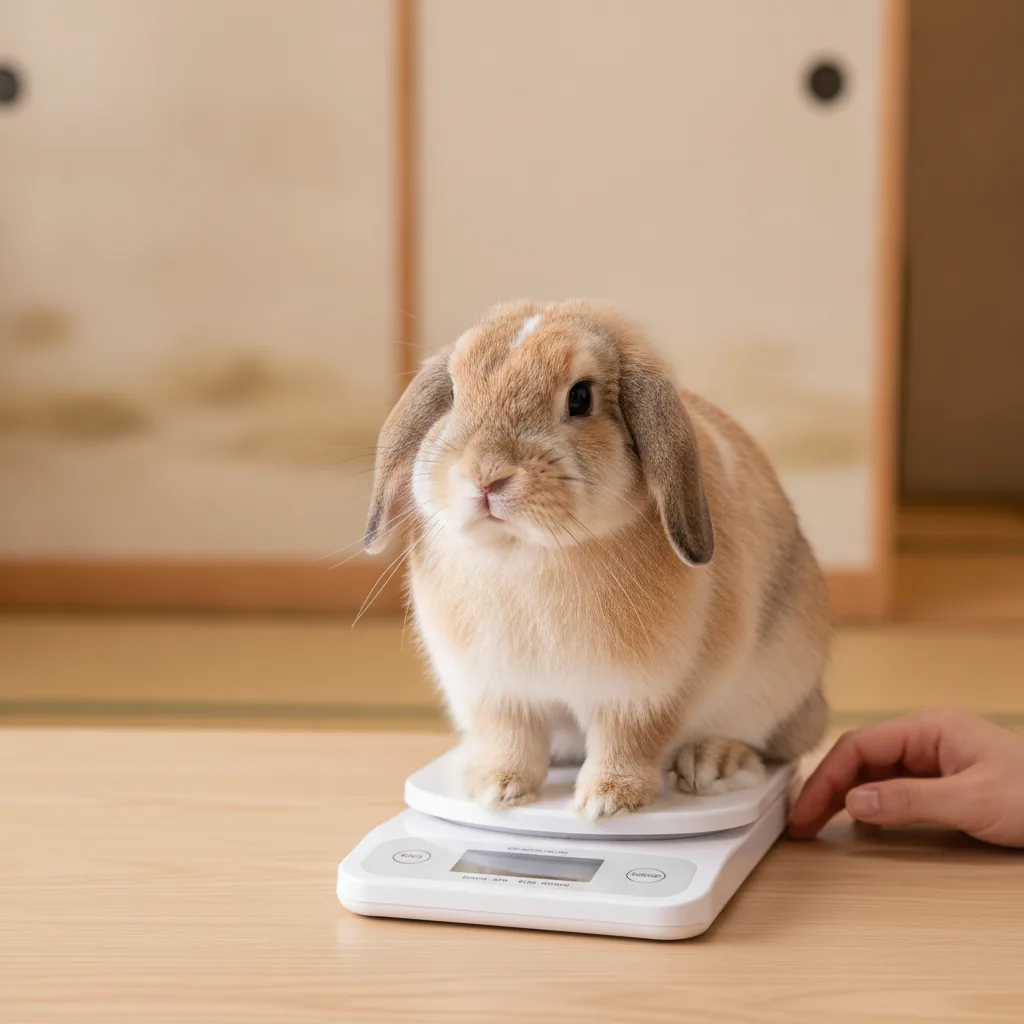
How often should I weigh a rabbit during a moult?
Weekly is a good guide. TVT asks for checks of weight and coat at least once a week.
TVT guidance sets out checking body weight, incisors, claws, all body openings and the coat at least once weekly. Weight and coat on the same schedule maps neatly onto what a moult requires.
Because shedding changes a rabbit's outline, appearance alone makes it hard to tell whether weight has actually been lost. Numbers are more reliable. The House Rabbit Society describes underweight rabbits as showing a prominent backbone, pelvis and ribs, with an abdomen that looks caved in rather than smooth.
Kaninchenwiese, for its part, writes that small amounts of fruit suit building up reserves for winter, implying some autumn gain is expected. That is a rabbit-keeping site's framing rather than a figure published by a veterinary body.
Should I increase hay during a moult, and what about pellets?
Hay is meant to be unlimited anyway, so the point is not running out rather than adding more. Be cautious with extra pellets.
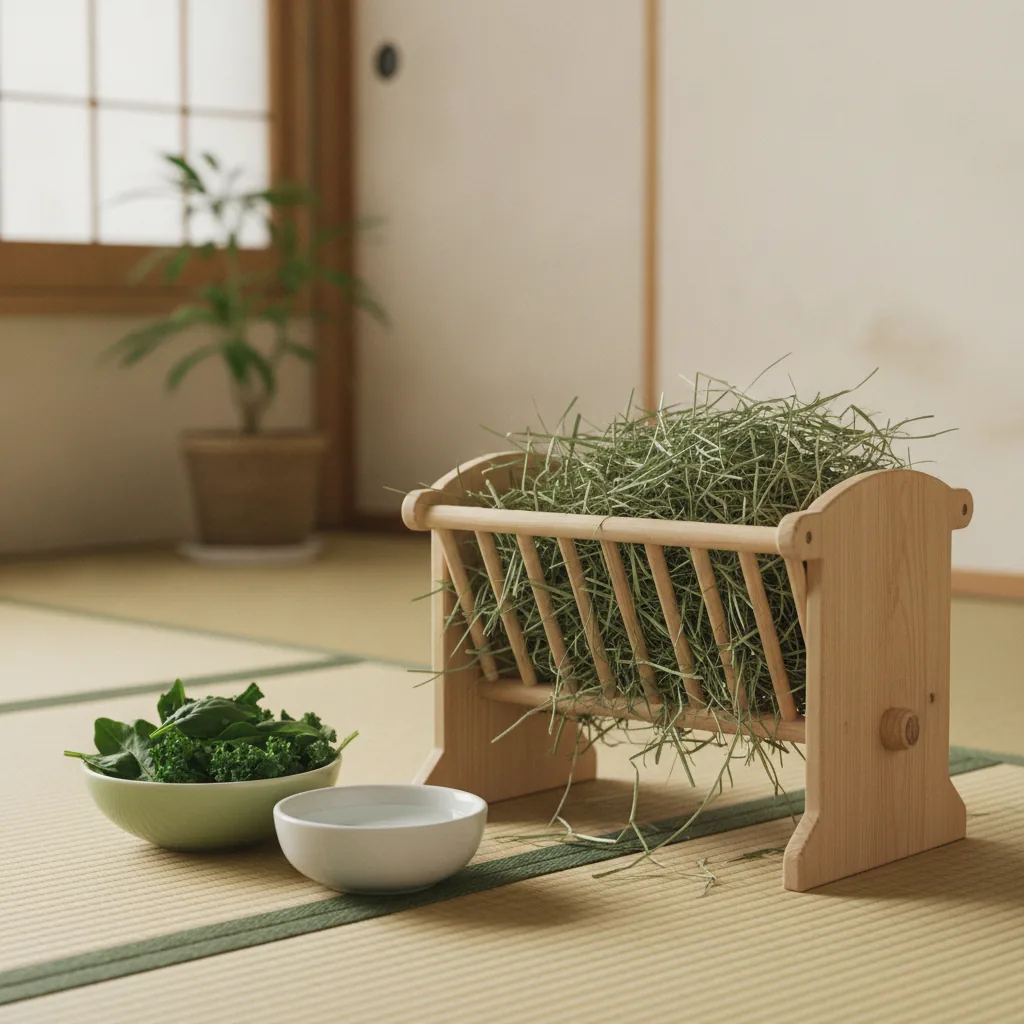
RWAF gives proportions of roughly 85% hay or grass, 10% leafy green vegetables and 5% extruded pellets or nuggets. On hay it says you cannot give a rabbit too much, and that supply should be unlimited.
For pellets the suggested amount is 15g per kg of body weight. When choosing them, RWAF suggests looking for high fibre of at least 20% and moderate protein of 12 to 15%.
Fur is made of protein, so raising protein during a moult sounds logical. In RWAF's framework, though, pellets are the 5% slice. Checking how much hay is actually being eaten comes first.
Is hay alone enough? Why does UK and German advice differ?
They build the base diet differently. The UK centres hay; the German veterinary body asks for fresh greens daily if hay is the only base.
RWAF writes that constant access to hay or grass is absolutely vital to keep the guts moving normally, and even more so when a rabbit is moulting.
TVT describes the base food as fresh or dried plant material — freshly cut meadow plants or high-quality hay. Where hay alone is fed, it states that a balanced mixture of fresh food must be given daily, suggesting around 200g of fresh food per kg of body weight, made up of 70% greens and herbs, 20% vegetables and no more than 10% fruit.
So the German veterinary position is not that hay is bad, but that hay alone is not enough. Kaninchenwiese goes further, arguing that a diet weighted towards dried material encourages hairballs, though that is the site's own position rather than veterinary guidance.
What both approaches share is the same core: keep fibre available and keep the gut moving. TVT also notes that dietary changes must be made slowly so gut flora can adapt, so a sudden autumn increase in fresh vegetables is best avoided.
Why does hydration matter during a moult?
Swallowed fur dries out and lingers when fluid is short. TVT asks for water to be available at all times.
RWAF notes that swallowing fur during grooming is normal in itself. Trouble arises when the hair dries out because of a sluggish gut, dehydration, or both.
TVT states that water must always be available, ideally in a bowl, even where a rabbit is fed entirely on fresh food. It adds that taking in plenty of fluid with food prevents urine from becoming too concentrated.
Once heating goes on, indoor air dries out. For the environment side of preparing for winter, see keeping rabbits warm in winter.
When should I contact a vet?
Droppings that are small, dry or fewer in number, a subdued rabbit, or no food for 24 hours. RWAF treats this as urgent.
RWAF writes that droppings which are small and dry, or becoming hard with less being produced, should ring alarm bells. It adds that a rabbit that is subdued or unwell in any way may be developing gut stasis, which needs urgent veterinary attention.
On grooming, RWAF notes that during a moult it may be necessary to brush a rabbit more than once a day. For how to approach that, see rabbit moulting season care.
Daily records make moulting changes easier to spot
Keeping weight, appetite and droppings side by side makes it easier to separate the moult from a change in health.
A moult changes how a rabbit looks from day to day, which makes "is this different from last week?" hard to answer from memory. The usagi Diary app lets you log weight, food and droppings in about thirty seconds, so you can show the timeline at a consultation and say when eating first tailed off.
Keep the record in the usagi Diary app
The log you keep is what you show the vet when something changes. Available on iPhone and Android.
Frequently asked questions
Should I feed more pellets during a moult?
Look at hay intake first. RWAF suggests about 85% hay or grass and roughly 5% pellets, around 15g per kg of body weight per day. Talk to your vet before increasing the amount.
How long does a rabbit's moult last?
It varies a lot. RWAF notes that house rabbits can have irregular patterns, and some appear to moult almost constantly rather than in clear seasonal bursts.
My rabbit gained a little weight this autumn. Is that a problem?
The German site Kaninchenwiese writes as though building up some reserve in autumn is expected. Judge by numbers though: TVT asks for weekly weight and coat checks, and a prominent spine warrants a vet visit.
My rabbit is eating less hay. What should I do?
Falling hay intake tends to slow the gut. If droppings are small, dry or fewer in number, contact a vet rather than waiting to see how things go.
Can I give more fruit or treats during a moult?
Sugary treats that displace hay can work against you. Keep any treats very small so that hay remains the staple part of the diet.
Related articles
Spotting Dental Trouble in Rabbits: Eating, Drooling, Face
Rabbit Weight: Weekly Weighing and Reading the Change
Rabbit Poop Guide: Size, Count and Caecotrophs
Rabbit Heatstroke: Signs, Prevention, and Safe Summer Setup
Rabbit Shedding Care: Brushing and the Real GI Stasis Risk
5 Things to Observe When Your Rabbit Isn't Eating
References
- Merkblatt Nr. 157: Kaninchen (Heimtierhaltung) [Guidance note no. 157: Rabbits (pet keeping)] / Tierärztliche Vereinigung für Tierschutz e.V. (TVT, German veterinary animal welfare association), Stand September 2019 (accessed 2026-09-14) Link
- Moulting / Rabbit Welfare Association & Fund (RWAF, UK) (accessed 2026-09-14) Link
- What to feed pet rabbits / Rabbit Welfare Association & Fund (RWAF, UK) (accessed 2026-09-14) Link
- Overweight and Underweight Rabbits / House Rabbit Society (US) (accessed 2026-09-14) Link
- Fellwechsel [Moulting] / Kaninchenwiese (German rabbit-keeping site) (accessed 2026-09-14) Link
- Kaninchen im Herbst [Rabbits in autumn] / Kaninchenwiese (German rabbit-keeping site) (accessed 2026-09-14) Link