Spotting Dental Trouble in Rabbits: Eating, Drooling, Face
Published
This article is based on literature research by our editorial team and has not been individually reviewed by a veterinarian. References are listed at the end of the article.
Please note: This article is not veterinary treatment. It is a summary of publicly available information from welfare organisations and veterinary practices. If you notice drooling, a change in how your rabbit eats, or weight loss, please contact a rabbit-savvy vet promptly.
What is malocclusion in a rabbit?
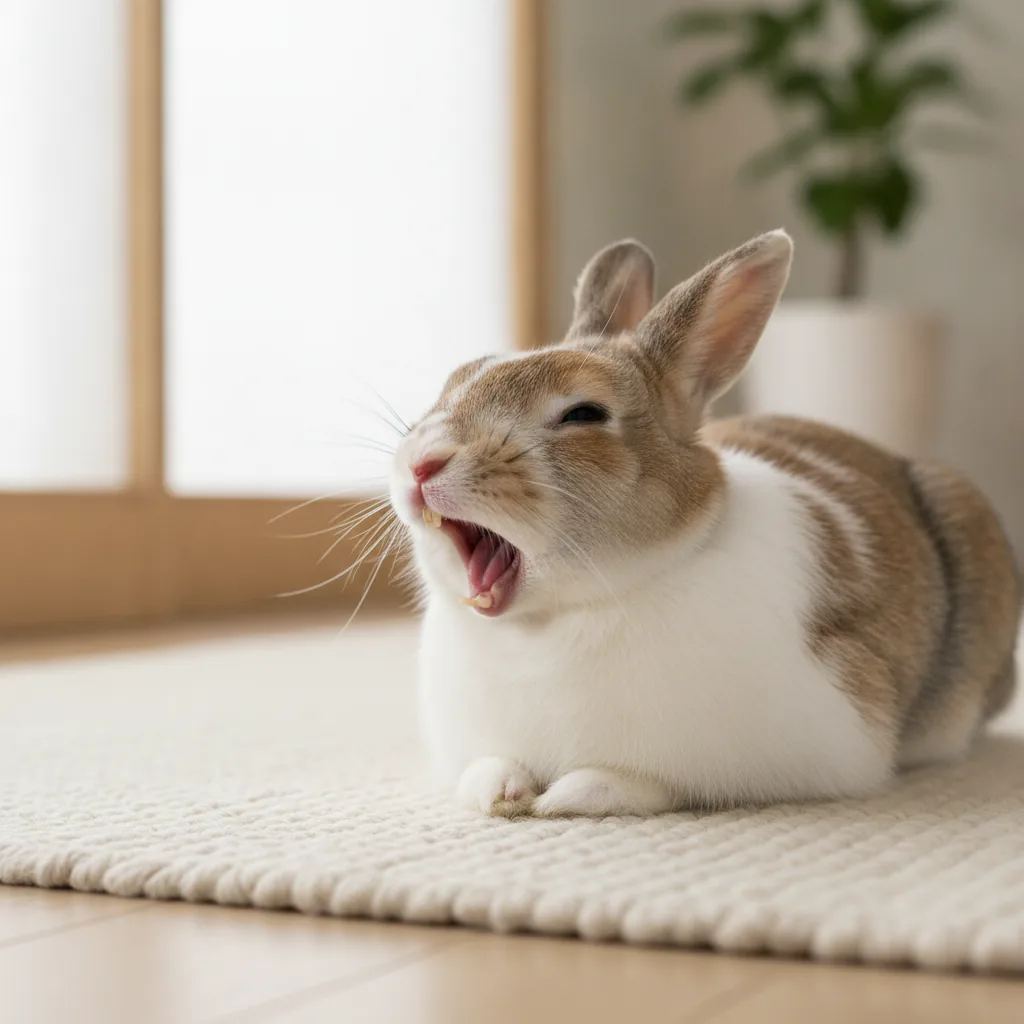
Teeth that have outgrown their bite. A rabbit's teeth never stop growing.
According to a Japanese guide from anicom, the growth is worn away by chewing fibrous grasses such as timothy, which keeps the teeth at a workable length. When something stops that wear, the teeth overgrow and the bite goes wrong. That is malocclusion.
How fast do they grow? The same publisher works it out, in a piece on the rabbit's ever-growing teeth, at roughly a centimetre a month. That is what daily chewing has to keep up with.
There are more teeth than most people expect: a dental formula of 16 upper and 12 lower, 28 in total, with six incisors — four above, including two small ones tucked behind the front pair, and two below. Trouble can start at the incisors or at the cheek teeth.
And anicom is blunt about the course of it: malocclusion does not resolve on its own, and tends to come back once it has happened.
What can I notice at home?
Changes in eating. "Hungry but unable to eat properly" is how it often begins.
The UK's PDSA lists these symptoms of dental disease:
- Overgrown teeth
- Weight loss
- A dirty bottom (grooming becomes difficult and painful)
- Diarrhoea or soft faeces
- Weepy eyes
- Drooling
- Reduced appetite
- Tooth grinding
- A bumpy, painful jaw
- A runny nose
- Lethargy
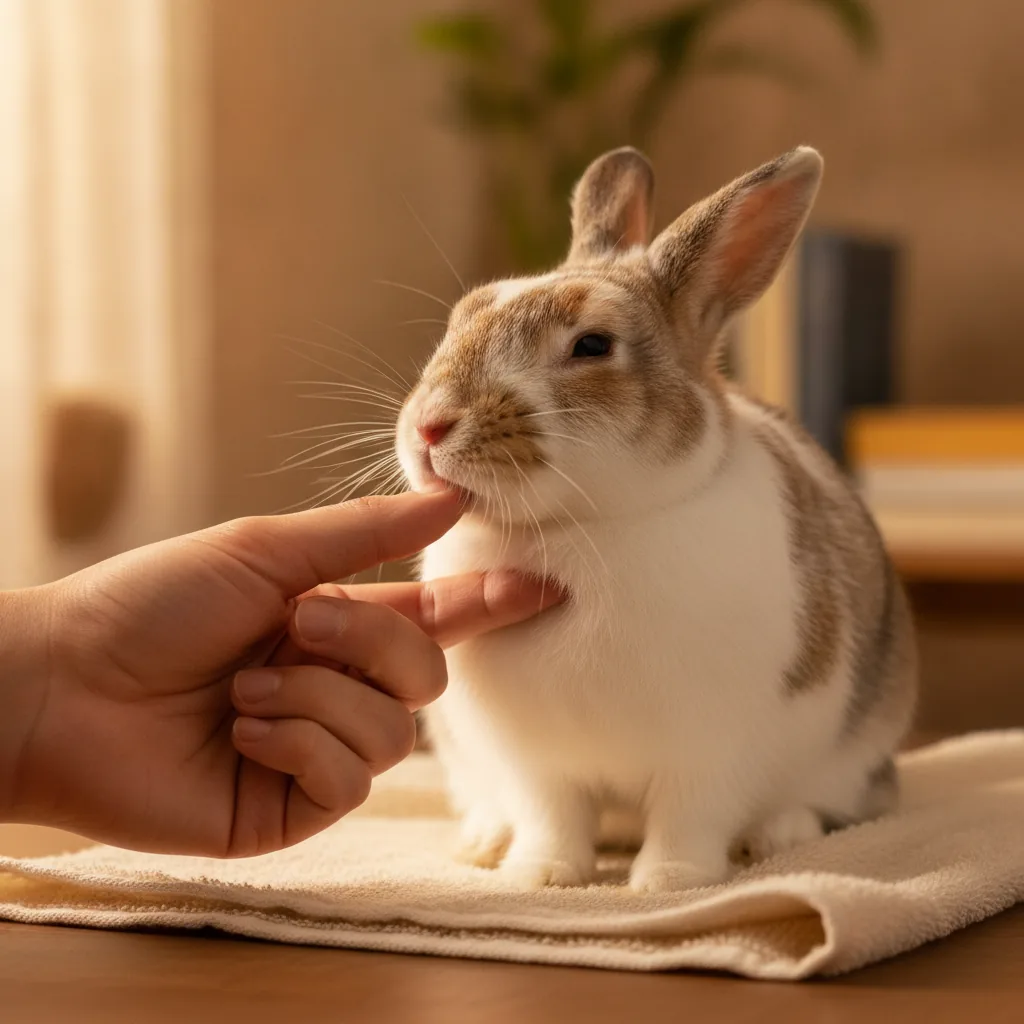
anicom fills in the finer behaviour: going to take food and then giving up, a shift in preference towards soft foods only, saliva staining the chin and front paws, droppings getting smaller, and weight coming off.
How to read smaller droppings and a falling weight is covered in "Rabbit Weight: Weekly Weighing and Reading the Change".
If the front teeth are overgrown, what about the back ones?
Very likely overgrown too — and those you cannot see at home.
PDSA writes that overgrown incisors cause problems eating, drinking, grooming and closing the mouth, and adds that if a rabbit's front teeth are overgrown, it is very likely the back teeth are as well.
anicom describes how a vet actually looks: malocclusion is confirmed visually, the incisors by eye, and the cheek teeth, which cannot be seen directly, with an otoscope placed in the mouth. If overgrown roots are suspected, radiographs may follow. And plainly: a rabbit's mouth is small, so an owner cannot really judge the cheek teeth from outside.
So home observation reaches the incisors and stops. Which is why watching how your rabbit eats beats trying to inspect teeth. By the time overgrown incisors are obvious, the back teeth may have been changing for a while.
What causes it?
anicom splits it four ways: diet, genetics, cage chewing and injury.
An unsuitable diet: a rabbit filled up on pellets, vegetables or soft food eats less hay, and the teeth lose their chance to wear down.
Genetics: breeds with a short jaw in profile — brachycephalic types — are described as more prone, with Netherland Dwarfs and Dwarf Hotots named as higher risk.
Chewing the cage: gnawing hard wire mesh is described as distorting the incisors over time.
Injury: a fall from height that hits the face can knock the bite out of alignment.
On the weighting, RWAF is unambiguous. Responding to a large 2024 study it wrote that the main cause of dental disease is by far the diet, with all other factors having much less impact. The breed side is covered in "The Netherland Dwarf: Traits and Health Points to Watch" and "The Holland Lop: Traits and What Lop Ears Ask of You".
Why does hay wear the teeth down?
Because it demands a side-to-side grinding action. No other food asks for the same movement.
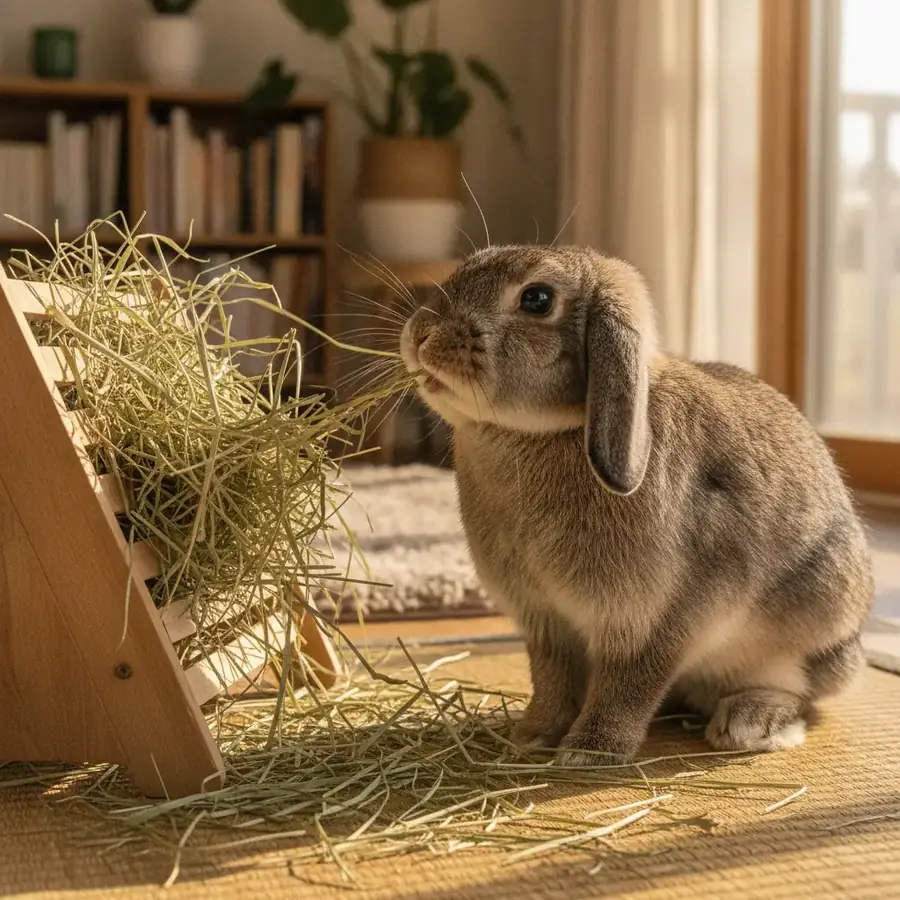
RWAF explains that the long fibre in hay has to be chewed side to side, and that is what wears the molars down — no other food does this. Hay also contains silica, which helps the wear.
The Japan Animal Medical Center, a Tokyo practice, makes the same link from the gut side: fibre balances the intestinal flora and keeps the digestive tract moving, while thorough chewing of coarse material keeps the teeth at a workable length. PDSA puts it simply: the best way to prevent dental problems is a well-balanced, high-fibre diet.
Choosing hay is covered in "Choosing Hay for Rabbits: Cuttings, Grass Types and Alfalfa".
What happens if it is left?
It stops being only about teeth. anicom describes effects throughout the body.
Pain, stress and not eating enough slow the gut, which can tip into stasis. Roots growing down towards the jawbone can become infected and form an apical abscess. When upper cheek tooth roots overgrow, they can press on the tear drainage, so the eye runs — and in some cases the eyeball is pushed forward. A rabbit that cannot groom develops a poor coat, and saliva or tears can cause moist dermatitis.
RWAF adds that the spurs forming on overgrown molars dig into the cheek and tongue, are extremely painful, and if left untreated the condition is fatal.
That is a heavy list, but the conclusion is simple. All of it is reached long after the eating changed.
When to see a vet, and what never to do
Check weekly at home, have a vet look a few times a year — and never cut the teeth yourself.
PDSA notes that rabbits hide pain, so regular checks matter: yourself once a week, your vet a few times a year. RWAF adds that if a rabbit is not eating properly the teeth are a likely cause, and that even a good mouth on a good diet can throw a spur — so a drop in appetite is reason to have all the teeth examined.
What does not belong at home is the treatment. In its 2024 response RWAF notes that many rabbits still have their teeth clipped, which can lead to fractures of the roots. If you find an overgrown tooth, do not trim or file it.
At the practice, anicom explains, the teeth are cut or burred back to a workable length, sometimes under general anaesthetic — and because the problem recurs, regular follow-up visits are usually part of it. What to watch when appetite drops is in "5 Things to Observe When Your Rabbit Isn't Eating".
A record of how they eat stands in for the teeth you cannot see
The cheek teeth are invisible at home. Appetite, droppings and weight are not — and that is where malocclusion shows first.
The usagi Diary app logs food, droppings and weight in about thirty seconds. "The hay is going down slowly", "only soft food today", "droppings look small" — any one day is noise; as a line it becomes a trend. Being able to tell a vet when it started is something only a record gives you.
Rabbits differ. When in doubt, a vet's advice comes before your own judgement at home.
Keep the record in the usagi Diary app
The log you keep is what you show the vet when something changes. Available on iPhone and Android.
Frequently asked questions
What are the signs of dental disease in a rabbit?
PDSA lists overgrown teeth, weight loss, a dirty bottom, diarrhoea or soft faeces, weepy eyes, drooling, reduced appetite, tooth grinding, a bumpy jaw, a runny nose and lethargy. Early on it often looks like wanting food but struggling to eat it.
Can I check the back teeth at home?
No. anicom notes that cheek teeth need an otoscope and that an owner cannot judge them from outside. PDSA adds that if the front teeth are overgrown, the back ones very likely are too.
How fast do rabbit teeth grow?
anicom works it out at roughly a centimetre a month. That growth is worn away by chewing fibrous hay, so a soft, low-fibre diet lets the teeth outpace the wear.
Can I trim an overgrown front tooth myself?
No. RWAF points out that many rabbits still have their teeth clipped and that this can fracture the roots. Overgrown teeth belong with a vet.
Can malocclusion be cured?
anicom describes it as a condition that does not resolve on its own and tends to recur. Even after the teeth are corrected, regular check-ups are usually needed.
Related articles
Rabbit Weight: Weekly Weighing and Reading the Change
Rabbit Poop Guide: Size, Count and Caecotrophs
Autumn Moulting in Rabbits: Diet, Weight and Warning Signs
Rabbit Heatstroke: Signs, Prevention, and Safe Summer Setup
Rabbit Shedding Care: Brushing and the Real GI Stasis Risk
5 Things to Observe When Your Rabbit Isn't Eating
References
- Dental problems in rabbits / PDSA (People's Dispensary for Sick Animals, UK) (accessed 2026-09-23) Link
- Rabbit Dental Problems / Rabbit Welfare Association & Fund (RWAF, UK) (accessed 2026-09-23) Link
- RWAF response to VetCompass dental disease frequency and risk factors May 2024 / Rabbit Welfare Association & Fund (RWAF, UK) (accessed 2026-09-23) Link
- うさぎがなりやすい病気の不正咬合ってなに?どんな症状が出る病気?うさぎの歯のケアはどうする? [What is malocclusion, the dental problem rabbits are prone to? Symptoms and dental care] / anicom Encyclopedia of Living with Rabbits (Anicom Insurance, Japan) (accessed 2026-09-23) Link
- うさぎの歯について徹底解説!クイズに挑戦しながらうさぎの歯の秘密を知ろう! [Rabbit teeth explained: learn their secrets through a quiz] / anicom Encyclopedia of Living with Rabbits (Anicom Insurance, Japan) (accessed 2026-09-23) Link
- うさぎに牧草は必要か [Do rabbits need hay?] / Japan Animal Medical Center (veterinary clinic, Tokyo) (accessed 2026-09-23) Link