
Outdoor Rabbits in Winter: Shelter, Insulation, Bedding
Published
This article is based on literature research by our editorial team and has not been individually reviewed by a veterinarian. References are listed at the end of the article.
Please note: This article is not veterinary treatment. It is a summary of publicly available information from welfare and veterinary organisations. Outdoor housing is normal in the UK and Germany but not everywhere, and this article is not an argument for moving a house rabbit outside. If you notice something unusual, please contact a rabbit-savvy vet promptly.
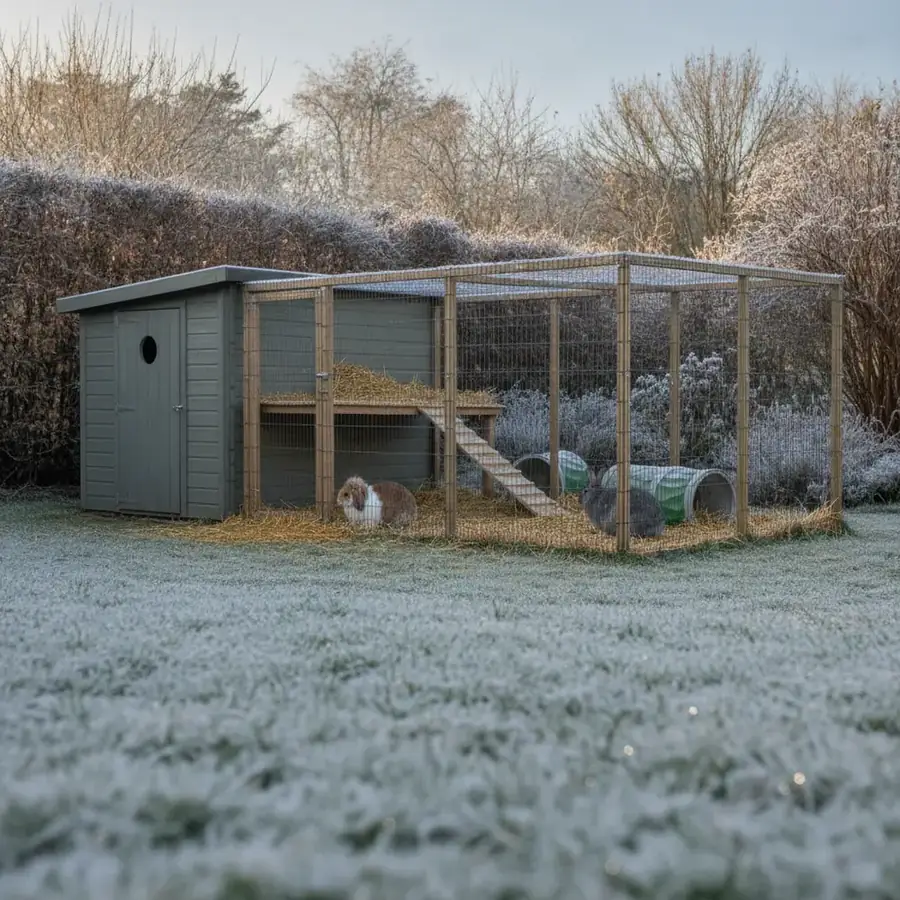
Can rabbits live outdoors through winter?
Yes — if the conditions are met. That qualifier is the whole article.
Germany's TVT, the veterinary association for animal welfare, writes that year-round outdoor housing, where the necessary conditions are met, comes closest to the animals' natural needs. In the same section it notes that conventional hutches are too small to house rabbits permanently on their own; combined with an outdoor run, they work.
The UK's RWAF puts it from the other side: rabbits are hardy and do not mind spending winter outside as long as they have a warm sleeping area at all times. Without that, the setup does not hold.
What temperature should the sleeping area be?
Around 10°C, steady — because that is what a wild warren is, RWAF argues.
Wild rabbits live underground, where the temperature barely differs between summer and winter (about 10°C). Pet rabbits do not have that luxury, so the owner has to provide permanent access to a sleeping area that is always warm enough, dry and free of draughts.
RWAF's second point carries almost more weight: avoid sudden changes. Moving from cold to warm and back can be very harmful. Bringing a rabbit indoors briefly in winter risks overheating if the room is too warm — the winter coat is lost, and going back outside becomes a shock.
A companion counts as heating too. In RWAF's phrase, it is like having a hot water bottle that stays warm all night.
Insulation and bedding — how should it be done?
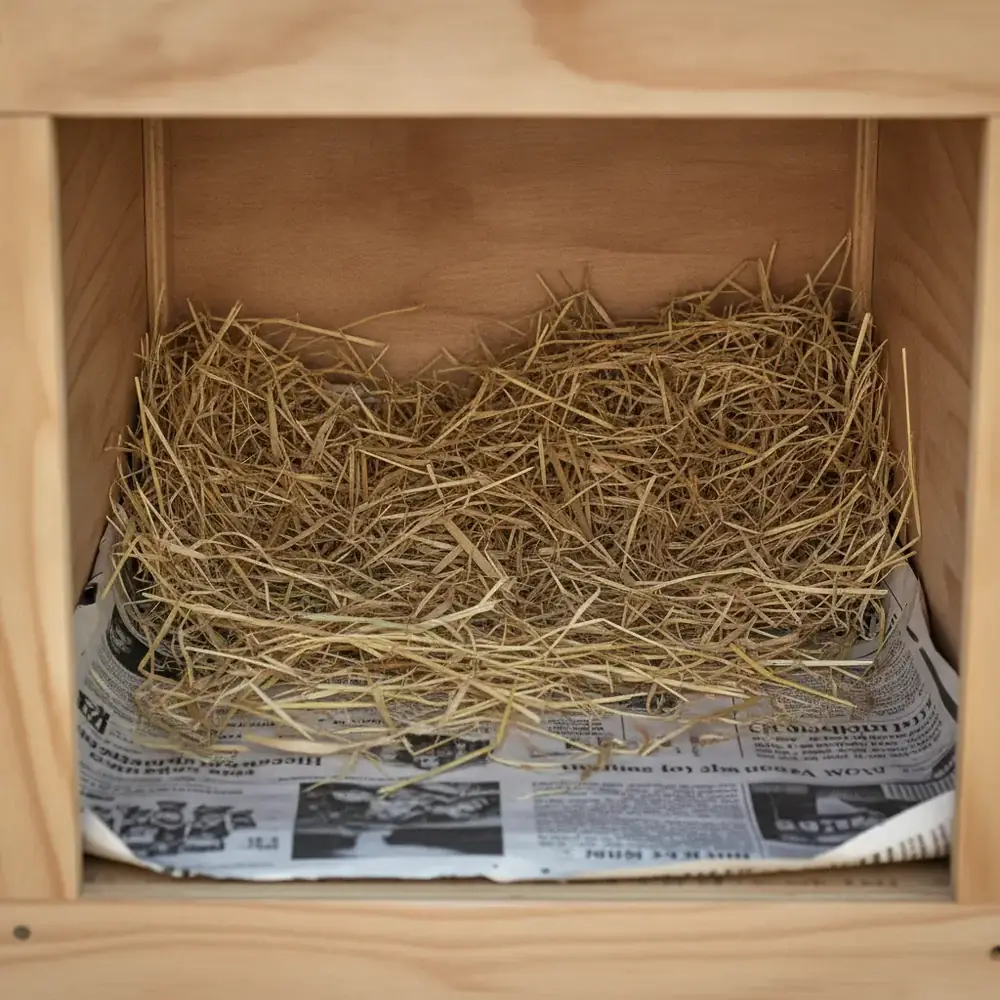
Insulation works, but sealing the box creates condensation. And you bed it with straw, not hay.
RWAF describes permanent insulation as making a real difference: line the inside with plywood, leaving a gap against the walls and floor, and fill that gap with roof insulation. Good bedding is still needed on top of it.
The TVT supplies the counterweight: condensation, for instance from excessive insulation, must be avoided in any case (mould!).
These do not contradict each other. What has to stop is draught, not air exchange. The RSPCA lists draughty, damp, hot, poorly ventilated and dirty environments as causes of suffering and disease. Read together: insulate, and at the same time leave moisture a way out.
On bedding RWAF is unambiguous: newspaper underneath and plenty of straw on top. Use straw rather than hay in the sleeping area, because straw is warmer and it is bedding, not food. Choose soft, dust-extracted bedding straw to reduce the risk of eye injuries and a dusty environment.
Fresh hay to eat still has to be available separately and in quantity. Choosing it is covered in "Choosing Hay for Rabbits: Cuttings, Grass Types and Alfalfa".
Is a heat pad a good idea?
Yes — on the condition that there are two sleeping places to choose between, RWAF says.
A well-insulated, draught-free sleeping area with good bedding and a companion is enough in most conditions, in RWAF's assessment. In extreme cold a heat pad can help — but with care.
The reason is simple: if the sleeping area gets too hot the rabbit leaves it and gets too cold outside. So give them the choice where possible — two sleeping areas, with a heat pad in only one of them.
The same principle applies indoors. It is covered in detail in "Rabbit Winter Care: Temperature and Where to Put a Heat Mat".
Do rabbits still need a run in winter?
Yes. RWAF writes that rabbits must never be permanently confined to a hutch.
Access to the run matters through winter, because grazing, running, digging and jumping are year-round needs. On top of that, rabbits are crepuscular, and moving them from hutch to run for a few daytime hours fits neither their body clock nor their instincts. Hutch and run stay connected at all times.
The TVT gives the dimensions: a structured outdoor run of at least 6 m² for two rabbits, plus 20% for each additional animal. Because three consecutive hops must be possible (one hop is about 80 cm), one side should be at least 2.4 m; the height such that a rabbit sitting up does not touch the roof with its ears. Shelters: at least one per animal, and at least one large enough for all of them to lie stretched out at the same time.
RWAF asks for a minimum of 1.8 m × 0.6 m × 0.6 m high where a traditional hutch serves as the bedroom — and nothing is shut inside it. What to have ready beforehand is in "Before You Bring a Rabbit Home: Checklist and Space".
How do you guard against predators, digging out and parasites?
With mesh, it comes down to measurements, not instinct.
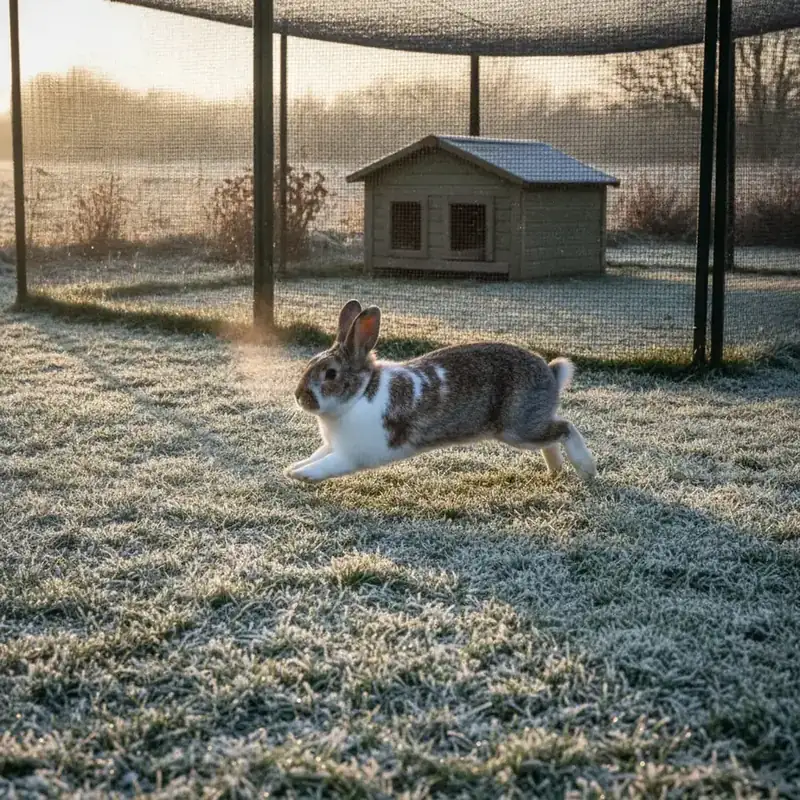
The TVT requires the run to be secure against digging out and to protect against predators such as foxes, martens, birds of prey and cats — the cast varies by region.
RWAF gets specific: use heavy welded mesh, because chicken wire gets chewed through. A wire gauge of 16g (1.2 mm) is the minimum recommended, 12g better. A mesh size of 13 mm is ideal; the 25 mm commonly sold will keep foxes and rats out but not small mustelids. Use bolts that take a padlock, and where the mesh is single-layer, fixing it on the inside of the frame is safer.
The RSPCA adds the construction side: raising a hutch off the ground guards against predators and damp, and wire floors are not recommended because they hurt the feet. For a run, mesh can be sunk into the ground and covered with soil and turf.
The TVT also notes that permanent outdoor housing calls for regular faecal testing for parasites. It states that vaccines against RHDV1+2 and myxomatosis are available and should be given regardless of housing type — but availability and schedules differ by country, so discuss vaccination with your own vet.
And the other season — what about heat?
Winter and summer are one plan. The TVT calls rabbits sensitive to heat; RWAF calls them hardy in the cold.
The TVT requires that half the area, and at least 3 m², is permanently shaded — with the sun's movement in mind, and the whole area for red-eyed rabbits.
For a sense of scale: in Japan, where rabbits are mostly kept indoors, the insurer anicom gives 18–24°C and 40–60% humidity as the range to aim for. Planning an outdoor setup means planning for midsummer at the same time.
Whether a rabbit is feeling the cold shows in its posture — see "Is My Rabbit Cold? Reading the Signs in Their Body Language".
A winter log makes next winter easier
Outdoors, conditions change day to day. Notes shorten the decision a year later.
The TVT recommends checking weight, incisors, claws, body openings and coat once a week, and seeking veterinary advice immediately if anything is off. Outdoors it is worth adding the day's temperature and whether there was frost — then you can see later which morning the appetite dropped.
The usagi Diary app logs food, droppings and weight in about thirty seconds. This winter's record is next winter's preparation.
Rabbits differ. When in doubt, a vet's advice comes before your own judgement at home.
Keep the record in the usagi Diary app
The log you keep is what you show the vet when something changes. Available on iPhone and Android.
Frequently asked questions
Can rabbits live outdoors through winter?
With the right conditions, yes. The TVT calls year-round outdoor housing the closest fit to a rabbit's natural needs, provided the requirements are met. RWAF says rabbits do not mind winter as long as the sleeping area is always warm.
What temperature should the sleeping area be?
RWAF points to the wild warren, which stays around 10°C summer and winter. The number matters less than avoiding sudden swings between warm and cold.
Does insulation cause condensation?
The TVT says condensation, for instance from excessive insulation, must be avoided because of mould. RWAF recommends permanent insulation. The aim is to stop draughts while still letting moisture escape.
Should I bed the shelter with hay or straw?
RWAF recommends straw rather than hay for bedding: straw is warmer and it is bedding, not food. Choose dust-extracted straw and provide plenty of fresh hay separately to eat.
Do rabbits still need a run in winter?
Yes. RWAF says access to the run matters through winter and that rabbits must never be permanently confined to a hutch. Hutch and run stay connected at all times.
Related articles
References
- Merkblatt Nr. 157: Kaninchen (Heimtierhaltung) [Information sheet no. 157: Rabbits (keeping as pets)] / Tierärztliche Vereinigung für Tierschutz e.V. (TVT, German veterinary animal welfare association), September 2019 (accessed 2026-09-24) Link
- Keeping Outdoor Rabbits Warm in Winter / Rabbit Welfare Association & Fund (RWAF, UK) (accessed 2026-09-24) Link
- Outdoor Housing / Rabbit Welfare Association & Fund (RWAF, UK) (accessed 2026-09-24) Link
- Rabbit environment / RSPCA (UK) (accessed 2026-09-24) Link
- 寒さ対策は大丈夫?うさぎが寒がらないようにするにはどうしたらいい?対策や気を付けること [Is your cold-weather setup enough? How to keep a rabbit from feeling cold] / anicom Encyclopedia of Living with Rabbits (Anicom Insurance, Japan) (accessed 2026-09-24) Link